Introduction
The alarm goes off after a short, broken night. The early flight, the deadline that keeps stretching past midnight, the baby that will not stay asleep. That state is almost a badge of honor in high‑pressure careers, yet the cost hides under the surface.
Sleep loss does far more than cause yawns. It measurably slows reaction time, weakens memory, and drags down mood. Brain imaging shows that after extended wakefulness the high‑energy phosphate fuels that power thinking, especially phosphocreatine, start to fall while acidic byproducts build up. Those changes show up in airline cockpits, hospital shifts, and late‑night driving records.
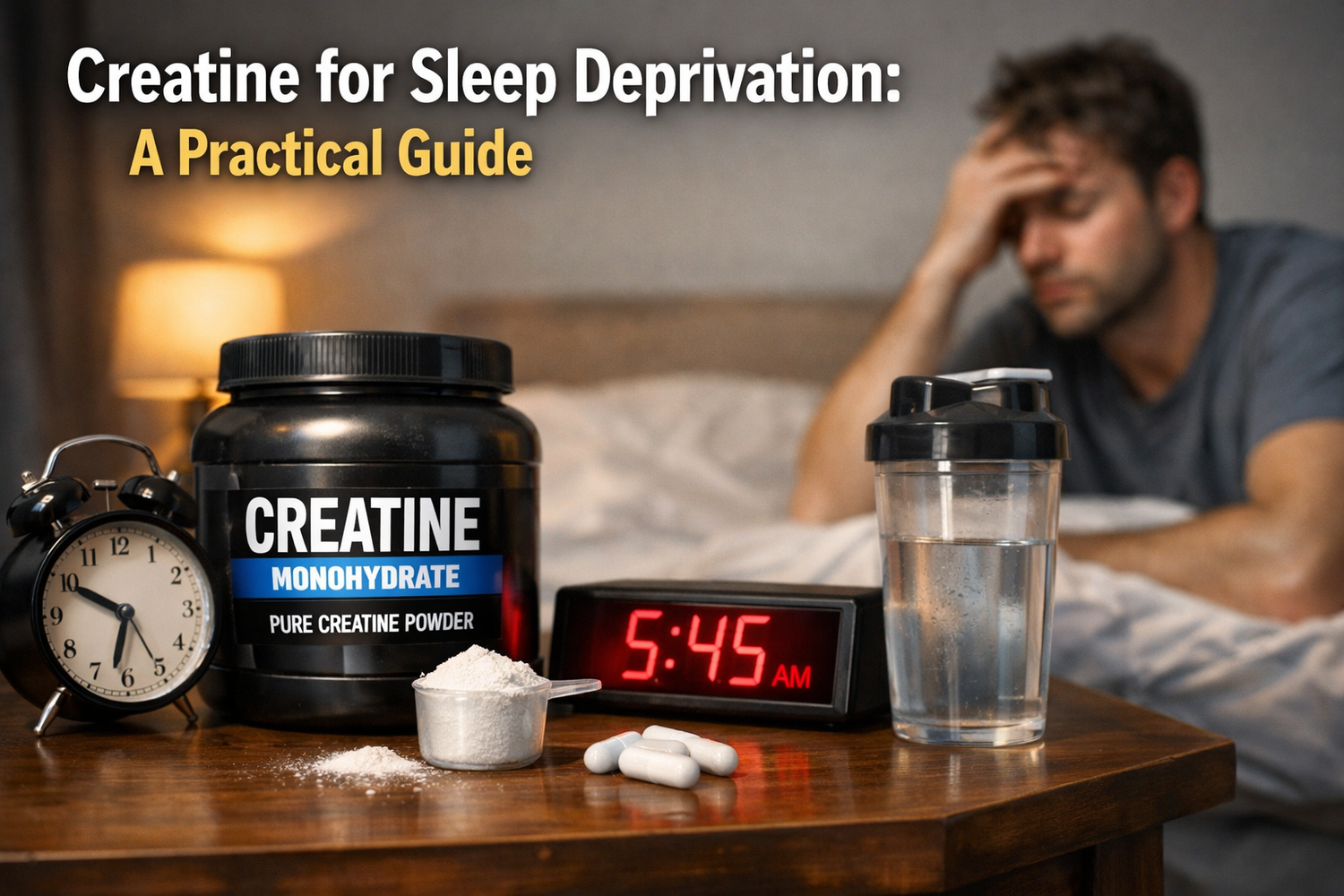
Most people reach for coffee. Fewer have heard about creatine for sleep deprivation, even though it targets the very energy systems that start to fail when sleep runs short. For someone who treats health as an investment, that idea is both interesting and a little surprising. Creatine comes from the gym aisle, not the sleep shelf, yet research now links creatine with better processing speed, memory, and mood under real sleep stress.
In this guide you will see:
-
how sleep loss depletes brain energy
-
what creatine actually does inside neurons
-
what recent human studies show about creatine for sleep deprivation
-
how creatine compares with caffeine
-
realistic dosing, safety points, and where creatine fits into a broader sleep strategy, including the rhythm‑first approach used by SLP1
Key Takeaways
-
Sleep deprivation puts the brain in an energy squeeze. Phosphocreatine (PCr) falls while inorganic phosphate (Pi) climbs. That pattern shows clear strain on ATP supply and helps explain slower thinking.
-
Creatine supports that same phosphocreatine system. By helping rebuild ATP, it can steady thinking when sleep is short. This is the central idea behind creatine for sleep deprivation as an energy support, not a stimulant trick.
-
In a recent human trial, a single large dose during partial sleep loss improved memory, processing speed, and fatigue ratings. Effects appeared a few hours after intake and lasted most of the night.
-
The blood‑brain barrier usually limits how much creatine reaches neurons, yet metabolic stress from sleep loss seems to open more transport capacity. That is one reason creatine may work differently on a sleepless night than on a well‑rested day.
-
Research‑grade doses are much higher than daily use and may strain kidneys, so they are not for self‑testing. For real life, modest daily creatine plus better sleep support from programs like the SLP1 protocol offers a more practical path that pairs energy support with deeper, more regular rest.
Why Sleep Deprivation Depletes Your Brain's Energy Supply

Sleep loss looks simple on the surface, yet inside the brain it behaves like a workout that never ends. Neurons fire for longer hours without the nightly reset that sleep brings. To keep up, they burn through their main fuel, adenosine triphosphate (ATP), at a faster rate. Over time the backup system that keeps ATP topped up starts to thin out.
ATP is the immediate energy coin for brain cells. Because ATP stores are tiny, the brain leans on phosphocreatine (PCr) as a quick recharge pool. When ATP is used, PCr donates a phosphate group so ADP can turn back into ATP and thinking can continue. This support loop has to work smoothly for attention, memory, and decision‑making to stay sharp.
Magnetic resonance spectroscopy studies in sleep‑deprived volunteers show a clear pattern:
-
the ratio of phosphocreatine to inorganic phosphate (PCr/Pi) drops
-
Pi itself rises
-
intracellular pH slides downward, meaning the environment inside brain cells becomes more acidic and less friendly for enzymes that run energy reactions
A falling PCr to Pi ratio is one of the clearest signs that a sleep‑deprived brain is short on usable energy.
Those chemical shifts explain why a person on very little sleep feels mentally clumsy. The Psychomotor Vigilance Test (PVT), which tracks small lapses and reaction times, slows down. Tasks that rely on working memory, like remembering number strings or lists of words, become harder, and processing speed for language or logic tasks stretches out. On busy roads or in high‑stakes jobs, that slower brain can have serious safety costs.
The picture is similar to a smartphone stuck on five percent battery while several heavy apps keep running in the background. The device still turns on, yet every swipe lags and any extra demand risks a sudden shutdown. If sleep deprivation drains the phosphocreatine system this way, it makes sense to ask what happens when creatine for sleep deprivation is added to refill that reservoir. This question sets the stage for creatine, the molecule that feeds the same PCr system that deeper sleep loss drains.
What Creatine Actually Does in the Brain (It's Not Just for Muscles)

Creatine is a small compound the body makes from the amino acids arginine, glycine, and methionine. It also comes from food, especially red meat and some fish. Athletes often think about creatine monohydrate for strength and power, yet the brain uses the same compound every second to keep thoughts running smoothly. That makes creatine for sleep deprivation a logical topic once you look closely at brain energy.
In both muscle and brain, creatine powers the creatine kinase system. This system works like a fast charger for ATP. When ATP breaks down to ADP during intense activity, phosphocreatine hands over a phosphate group so ATP can be rebuilt in place.
PCr + ADP + H⁺ ↔ Cr + ATP
In the brain, a specific form of the creatine kinase enzyme, often called CK‑BB, carries out this swap. It sits close to the spots in neurons where energy use changes quickly, such as synapses. That placement means creatine can buffer local energy dips before they spill over into lost function or signal failure.
Over the past two decades, studies of regular creatine intake have shown modest gains in memory and reasoning tasks, especially under:
-
stress
-
mental fatigue
-
vegetarian or low‑meat diets that supply little creatine
In models of low oxygen or other energy challenges, higher brain creatine often protects cells from damage. There is also evidence that creatine can influence neurotransmitter activity in ways that support stable mood and mental clarity, both of which are stressed during sleep loss.
So why are creatine for sleep deprivation and other brain‑focused uses only now coming into wider focus? A key reason is that the brain is harder to saturate with creatine than muscle because of the protective blood‑brain barrier. To understand what recent research means, it helps to look at that barrier next.
|
Aspect |
In Muscle |
In Brain |
|---|---|---|
|
Main job |
Support short bursts of high‑force work such as lifting or sprinting |
Support rapid thinking, signaling, and information processing all day |
|
Energy demand pattern |
Short, intense peaks with clear rest periods |
Constant activity with surges during focus, stress, and sleep loss |
|
Effect of extra creatine |
Noticeable strength and power gains in many users |
Subtler gains, often seen under stress, low dietary creatine, or sleep deprivation |
The Blood-Brain Barrier Problem — and How Sleep Deprivation May Solve It
The idea of creatine for sleep deprivation sounds simple, yet the biology is not. The brain sits behind a selective border that keeps many helpful compounds, including most supplemental creatine, from rising quickly inside neurons.
Why the Brain Is Resistant to Creatine Supplementation Under Normal Conditions
Unlike muscle, the brain cannot freely soak up substances from the bloodstream. Cells lining blood vessels form a tight barrier and only allow passage through dedicated transporters. For creatine the entry gate is a protein called the creatine transporter, often labeled SLC6A8 or CreaT.
Under normal, well‑rested conditions this transporter works close to full capacity. Raising blood creatine by taking a single standard dose may increase muscle stores, yet brain uptake barely moves. On top of that, the brain can make its own creatine from amino acids, so it relies less on what comes from food or supplements.
In practice, this means many early studies that measured brain creatine needed at least one to four weeks of daily intake before magnetic resonance scans showed a clear rise. Short‑term experiments that lasted only a few days often detected no change at all. For years that led many experts to doubt that creatine for sleep deprivation could work in a quick, same‑day way.
How Sleep Deprivation Changes the Equation
Sleep deprivation, however, changes the chemistry on both sides of that transporter. When the brain stays awake far past its usual window, metabolic byproducts begin to build. One of them is ammonia, which rises in brain tissue during long periods of wakefulness.
Research in other models shows that high ammonia can increase expression of the SLC6A8 transporter in supportive cells known as astrocytes. With more transporter present at the blood‑brain barrier, creatine from the bloodstream can move into the brain more easily, at least for a limited time. This potential shift is one bridge between sleep loss and creatine for sleep deprivation as a fast‑acting tool.
At the same time, sleep loss makes the inside of neurons more acidic. To correct that, cells pump out hydrogen ions using sodium‑linked exchangers. That pump action drives the sodium‑potassium ATPase harder, which strengthens the sodium gradient that powers creatine transport into cells.
Add a large rise in blood creatine on top of this primed state and the creatine kinase system inside neurons shifts toward faster recycling of ATP. In plain terms, the stressed, sleep‑deprived brain seems to open a window where creatine for sleep deprivation can get in and be used more quickly than under normal conditions.
What the Research Actually Shows — Acute vs. Chronic Dosing
The scientific case for creatine for sleep deprivation comes from two main lines of human research. One tests a single very high dose during a night of restricted sleep. The other uses a short loading phase over several days before a sleepless stretch.
The 2024 Jülich Study — A Single High Dose Under Sleep Deprivation

In 2024 a team at Forschungszentrum Jülich in Germany ran a tightly controlled experiment with fifteen healthy adults. Participants stayed awake for about twenty‑one hours, spending the night in a lab while completing repeated cognitive tests. In a double‑blind, crossover design, each person received either creatine monohydrate on one visit or a matching placebo on another.
The creatine dose was much higher than normal daily use, equal to 0.35 grams per kilogram of body weight in a single serving. For someone who weighs around 176 pounds (80 kilograms), that comes to roughly 28 grams at once. After intake, researchers followed changes in blood creatine, brain chemistry, and test performance for several hours.
Compared with placebo nights, the creatine condition showed better scores on:
-
word memory tasks
-
number span tests
-
processing speed for language, logic, and numeric problems
-
reaction times on the Psychomotor Vigilance Test, which slowed far less
Participants also reported feeling less fatigued on a standard sleepiness scale, which fits well with the idea of creatine for sleep deprivation as an energy buffer.
Magnetic resonance spectroscopy confirmed that total creatine in the parietal brain region rose. Creatine also held brain pH steadier and prevented the usual drop in the phosphocreatine to inorganic phosphate ratio seen with sleep loss. Benefits began around three hours after the dose, peaked near four hours, and remained measurable for up to nine hours.
Under real sleep stress, the human brain in this trial absorbed and used creatine much faster than earlier work suggested.
Chronic Loading — The McMorris Et Al. Evidence
An earlier study led by McMorris and colleagues took a different path. Volunteers consumed 5 grams of creatine monohydrate four times per day for seven days, a classic loading phase used in sports nutrition. They then stayed awake for twenty‑four hours while performing mild exercise and a series of mental tasks.
Compared with placebo, the creatine group held mood steadier on questionnaires taken after the sleepless night. They also did better on executive‑function tasks that depend on the prefrontal cortex, such as random movement generation and choice reaction time. Static balance, which often suffers with fatigue, was better maintained as well.
Blood tests did not show big differences in stress hormones, which points back to brain energy metabolism as the likely driver of these effects. This protocol used a total daily amount similar to what many athletes already take, making it more realistic than the very large one‑time dose, even though the exact impact of creatine for sleep deprivation at lower daily intakes still needs more study.
Creatine vs. Caffeine — Two Very Different Approaches to Fighting Fatigue

When sleep is short, caffeine is the usual first move. It works quickly and feels obvious, which is why it is the most used psychoactive compound worldwide. Creatine for sleep deprivation takes a slower, quieter route. The two tools act on different parts of the fatigue story.
Caffeine mainly blocks adenosine receptors in the brain. Adenosine builds up during wakefulness and signals sleep pressure. When those receptors are blocked, the feeling of tiredness fades for a while even though the real energy state of neurons has not changed. That can help with short‑term alertness, but it can also bring jitters, anxious feelings, and later trouble falling asleep, especially with afternoon or evening use.
Creatine acts as an energy substrate rather than a stimulant. By raising phosphocreatine, it supports faster ATP recycling where energy demand is highest. Instead of turning off the low‑battery warning, creatine for sleep deprivation aims to raise the battery level itself. There is no spike in heart rate, no change in adenosine signaling, and no buzz.
A simple way to picture it is with a phone. Caffeine is like turning off all battery warnings and forcing the screen to stay bright even at one percent. Creatine is like plugging the phone into a small external battery so it keeps running longer without drama. For many health‑focused professionals, that steadier profile is part of the appeal of creatine during hard weeks.
|
Feature |
Caffeine |
Creatine |
|---|---|---|
|
Main action |
Blocks adenosine to mask sleep pressure |
Supports phosphocreatine and ATP recycling |
|
Onset |
Minutes |
Hours |
|
Perceived effect |
Strong, noticeable buzz for many people |
Subtle, often felt as steadier focus under stress |
|
Common issues |
Jitters, pulse changes, lighter sleep when taken late, tolerance |
Possible stomach upset in some users, need for regular intake |
|
Fit with sleep goals |
Can interfere with sleep if timed poorly |
Does not appear to disturb sleep architecture in healthy adults |
Current research has not fully mapped how creatine and caffeine might work together during sleep loss. For now, it is safest to see creatine for sleep deprivation as deeper energy support and caffeine as a short‑term alertness tool that needs careful timing.
Dosage, Safety, and What to Realistically Expect
The most eye‑catching data on creatine for sleep deprivation comes from a single, very high dose. That same fact is also the main safety warning. The 0.35 grams per kilogram used in the Jülich study gave clear benefits in a lab setting, yet it is far above what is advised for casual use. For an average adult, it can mean 20–30 grams in one serving, which may place extra load on the kidneys, especially in anyone with reduced kidney function.
For daily life, guidance for creatine stays within more traditional ranges. Many people either start with a loading phase of 20 grams per day, split into four 5‑gram servings for five to seven days, then shift to a maintenance dose. Others skip loading and go straight to maintenance.
A common maintenance dose is 3–5 grams of creatine monohydrate per day. This range has a long record of use in healthy adults with a strong safety profile when combined with good hydration. Starting at the low end and staying consistent allows creatine to build up in muscle and, more slowly, in the brain over several weeks. That steady background level is the most realistic way to use creatine for sleep deprivation as support when hard weeks or night shifts appear.
Expectations also matter:
-
At standard doses, creatine is unlikely to feel dramatic from day to day.
-
Gains tend to show up as better resilience when you push hard, not as a sudden mental jolt.
-
For sleep loss, that can mean slightly better focus, mood, and reaction time during stretches when you previously felt completely drained.
If you have kidney disease, major medical conditions, or take medications that affect fluids or blood pressure, a conversation with a health professional before using creatine is wise. More research still needs to define the lowest effective amount of creatine for sleep deprivation in healthy people and in those with specific health needs.
Addressing the Root Cause — Why Better Sleep Still Matters Most

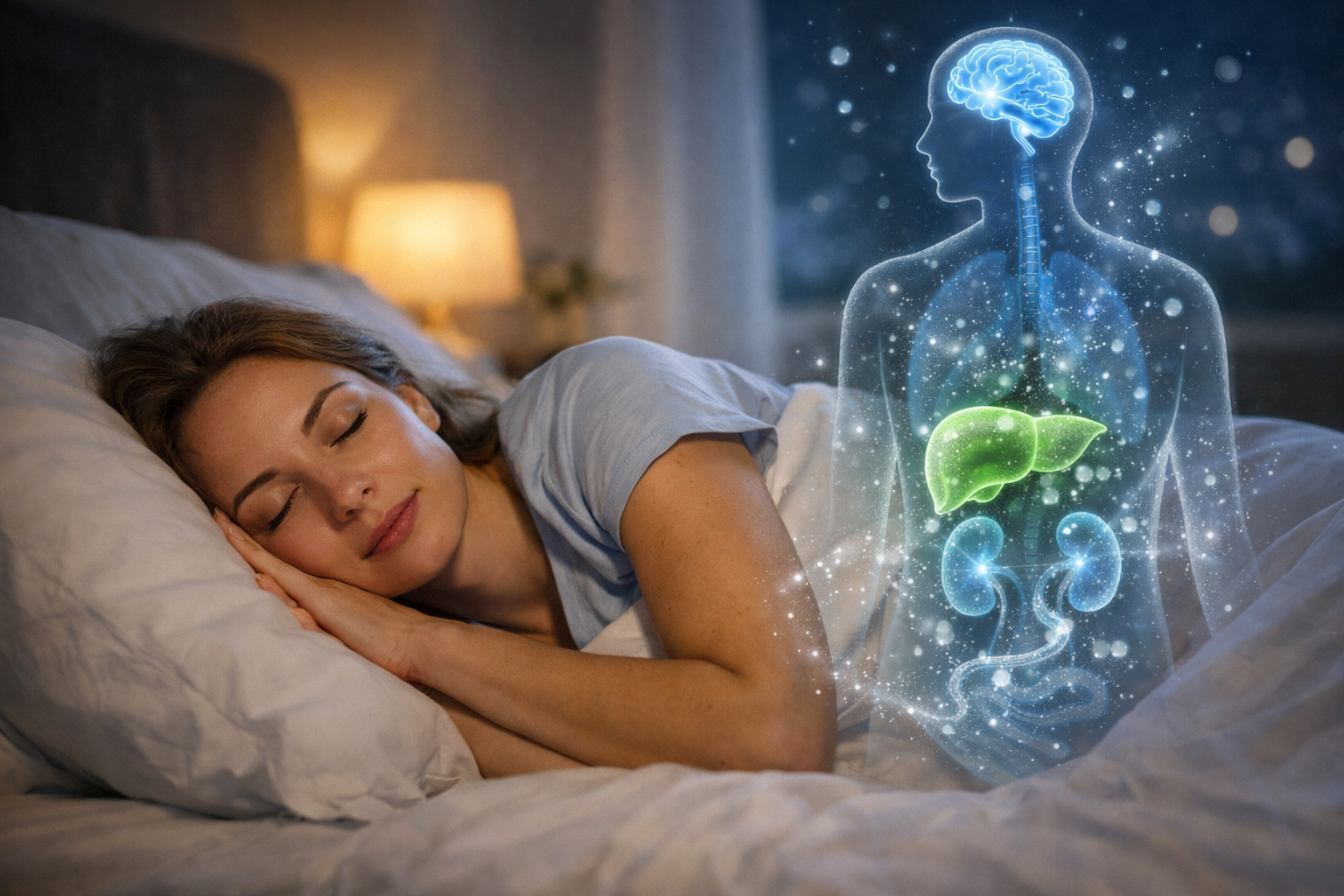
Creatine for sleep deprivation can help the brain cope with limited rest, yet it does not replace what sleep itself gives your body. A full night of quality sleep drives cellular cleanup, immune signaling, hormone balance, and memory consolidation. No supplement can stand in for stages like slow‑wave sleep and REM where that work happens.
“Sleep is the single most effective thing we can do to reset our brain and body health each day.”
— Matthew Walker, PhD, neuroscientist and sleep researcher
It helps to see creatine as support when sleep loss cannot be avoided, not as a pass to live on four hours per night. The more often you cut sleep, the more strain you place on blood sugar control, appetite hormones, cardiovascular health, and mood. Managing those deeper patterns calls for a plan that rebuilds a healthy rhythm, not only a safety net for emergencies.
This is where the philosophy behind SLP1 comes in. Instead of pushing heavy sedation, SLP1 focuses on restoring the body’s own timing with a three‑part protocol called Get to Sleep, Deeper Sleep, and Stay Sleep. Ingredients such as magnesium glycinate, beta‑hydroxybutyrate salts, glycine, tart cherry, apigenin, and carefully chosen B vitamins are combined to calm the nervous system, support brain metabolism at night, and line up internal clocks with the external day–night cycle.
Used consistently, that kind of rhythm‑first support can make the nights between stressful events much more restorative. When those stronger nights are in place, tools like creatine for sleep deprivation can play a smaller, more targeted role for rare all‑nighters, travel, or demanding shifts, instead of covering for chronic sleep debt.
-
Creatine helps with the energy side of sleep loss. It supports phosphocreatine and ATP so your brain can think more clearly when you must stay awake. It does not repair the deeper biological processes that only sleep can handle.
-
High‑quality sleep restores systems creatine cannot touch. It supports immune balance, hormone patterns, memory consolidation, and long‑term heart and brain health. Combining better sleep support from approaches like the SLP1 protocol with thoughtful use of creatine for sleep deprivation gives a far more stable path than relying on stimulants alone.
“A good laugh and a long sleep are the best cures in the doctor’s book.”
— Traditional Irish proverb
Conclusion
Creatine is far more than a gym supplement. Inside the brain it sits at the center of the phosphocreatine system that keeps ATP flowing to hungry neurons. When sleep runs short, that system shows clear signs of strain, and recent research suggests that extra creatine for sleep deprivation can soften the hit to memory, processing speed, and mood.
The evidence points to two main strategies:
-
a very high acute dose during controlled sleep loss, which is promising scientifically but not meant for home use
-
standard daily intake of creatine monohydrate in the 3–5 gram range, building a background reserve that may help during demanding weeks or occasional all‑nighters
At the same time, no amount of creatine can substitute for deep, regular sleep. Supporting your natural sleep architecture with rhythm‑minded tools, like the SLP1 protocol and its melatonin‑free, science‑guided ingredients, addresses the root need while creatine for sleep deprivation acts as helpful, secondary support. Understanding how your brain makes and spends energy gives you a stronger base to make choices about supplements, caffeine, and sleep that fit your long‑term health, not just the next deadline.
FAQs
Does Creatine Help With Sleep Deprivation?
Emerging research suggests that creatine can blunt some of the mental decline that follows lost sleep. In controlled studies, creatine during sleep restriction improved memory, processing speed, and reaction time while lowering feelings of fatigue. Regular daily intake in standard doses may also support brain energy reserves so you cope better when short nights appear.
How Much Creatine Should I Take for Sleep Deprivation?
The very high one‑time dose used in the Jülich trial was designed for a lab setting and should not be copied at home. For most healthy adults, 3–5 grams of creatine monohydrate per day is the best‑studied range. Some people choose a short loading phase of 20 grams per day for several days, but this is optional rather than required for creatine for sleep deprivation support.
Does Creatine Affect Sleep Quality?
Creatine is not a sedative and does not directly make you sleepy. Current evidence suggests it does not disturb normal sleep stages in healthy adults. Unlike caffeine, it has no stimulant action that would keep you awake. By supporting better brain energy balance, it may even help your brain carry out its nightly recovery work more efficiently once you do get to bed.
Is Creatine Better Than Caffeine for Staying Alert When Sleep-Deprived?
Creatine and caffeine work in very different ways, so one is not simply better in every case. Caffeine blocks adenosine and gives a strong, fast sense of alertness but can lead to jitters, reliance, and lighter sleep later on. Creatine for sleep deprivation supports the underlying energy systems and has a slower onset with steadier effects. Many people use caffeine for rare acute needs and creatine as quiet, ongoing support for resilience during stressful periods.

Leave a comment
This site is protected by hCaptcha and the hCaptcha Privacy Policy and Terms of Service apply.