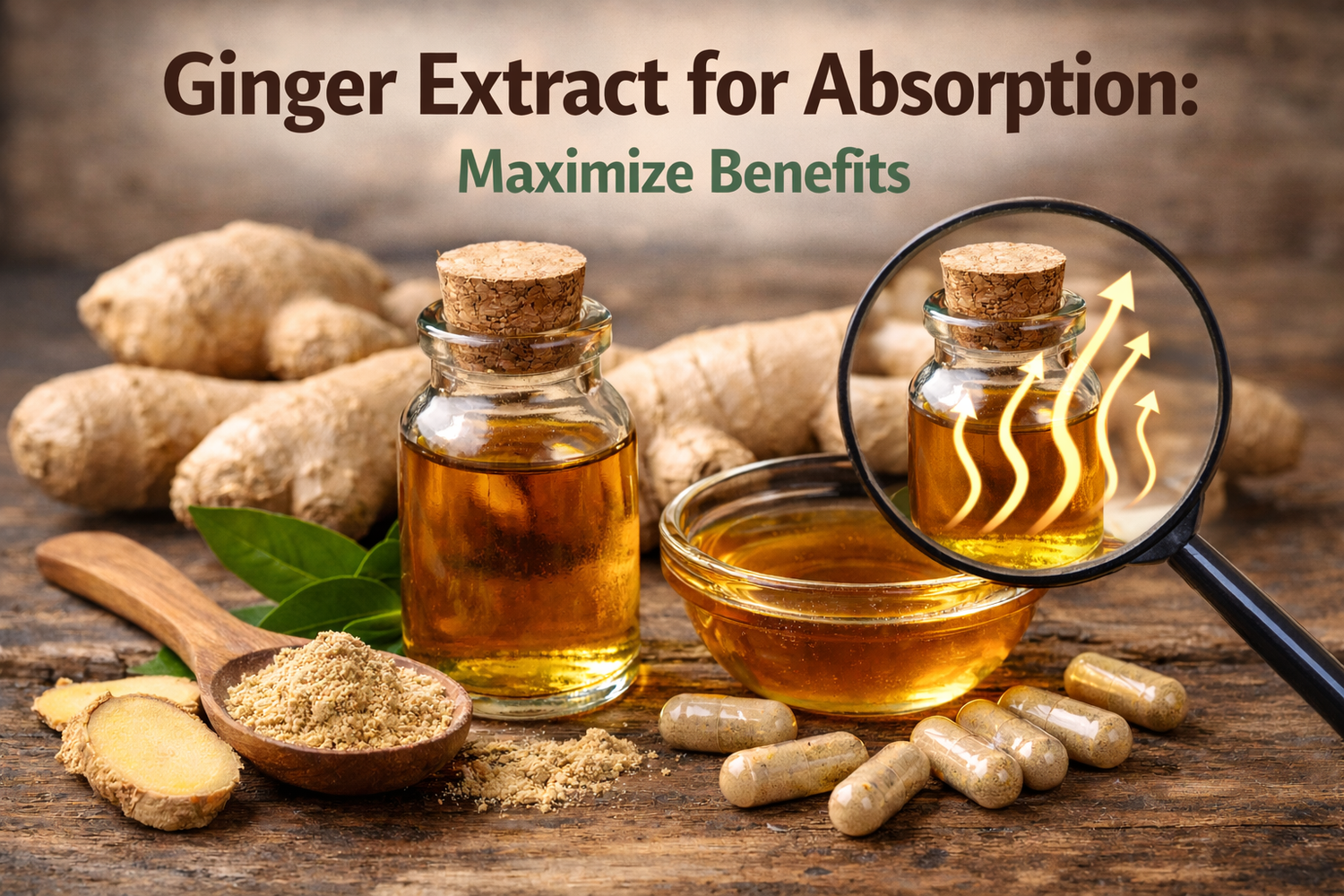
Benefits Of Ginger Extract For Better Absorption
A lot of people swear by ginger shots, ginger tea, and ginger capsules. Yet many still deal with nausea, restless sleep, and low energy. That gap between effort and outcome is where the science of ginger extract for absorption starts to matter.
Ginger has over two thousand years of therapeutic use behind it, and modern research supports much of that history. The star players are phenolic compounds called gingerols and shogaols. They support digestion, calm inflammation, and protect cells from oxidative stress. On paper, ginger looks like a dream ingredient. In practice, most standard ginger extract barely reaches meaningful levels in the bloodstream.
The main issue is not that ginger extract cannot cross the gut wall. The core problem is what happens next. Up to ninety‑nine percent of those active compounds are modified by the body through first-pass metabolism before they have a chance to act. That means many ginger supplements, no matter how strong the label sounds, provide very little systemic benefit.
As many nutrition‑focused clinicians like to say, "It’s not what you take, it’s what your body can use."
This article walks through that full story in plain language. You will see why absorption and metabolism matter more than dose, how ginger extract for absorption can be designed to work with human biology, and how SLP1 applies this science inside its sleep formula. By the end, you will be able to separate marketing from meaningful design and choose ginger products that actually deliver.
Key Takeaways
Before going deep into the science, it helps to have a quick map of the most important points about ginger extract for absorption. Think of these as the main reference points you can come back to later.
-
The main barrier for ginger is first-pass metabolism, especially Phase Two glucuronidation. Gingerols and shogaols cross the gut wall without much trouble, yet they are rapidly turned into water‑soluble conjugates that the body excretes. Studies show 10–700 times more of these compounds appear in the blood when researchers chemically free them from those conjugates, which reveals how much is locked away in inactive form.
-
Standard ginger capsules do not solve this metabolic wall. Raising the dose only raises the amount that the liver and intestinal enzymes convert to inactive forms. Advanced delivery systems such as liposomal formats and nano‑particle designs focus on ginger extract for absorption by helping more active compounds reach circulation as free gingerols and shogaols. These designs make smaller doses far more effective.
-
Quality and context decide whether ginger actually helps. Third‑party testing, cGMP manufacturing, and clean formulas separate serious products from marketing talk. In sleep‑focused blends such as SLP1’s Deeper Sleep, ginger does double duty. It supports absorption across the formula and helps ease pain and discomfort that can block deep rest, which leads to better sleep outcomes without harsh sedatives.
What Makes Ginger Extract Therapeutically Valuable: Understanding The Active Compounds

Ginger, from the plant Zingiber officinale Roscoe, is much more than a spicy kitchen staple. The rhizome holds over four hundred natural compounds, yet a small group of phenolics explains most of the researched health effects, as documented in comprehensive systematic reviews of ginger's therapeutic properties. These are the gingerols and their heat‑derived cousins, the shogaols.
The best studied gingerols are 6‑gingerol, 8‑gingerol, and 10‑gingerol. They give fresh ginger its sharp bite and show strong antioxidant and anti‑inflammatory activity in lab and animal models. When ginger is dried or heated, some gingerols convert into shogaols, especially 6‑shogaol. Shogaols tend to be more potent in several tests, which means dried extracts can, in some cases, act more strongly than fresh root on a milligram‑to‑milligram basis.
Key members of this group include:
-
6‑gingerol
-
8‑gingerol
-
10‑gingerol
-
6‑shogaol
From a chemistry point of view, these compounds look very suitable for oral use. They fit well within well‑known drug‑likeness rules such as the Lipinski Rule of Five and Veber’s guidelines. Their molecular weight stays under five hundred daltons, and their polar surface area remains under one hundred forty square angstroms. Those features predict good membrane crossing, which supports the idea that ginger extract for absorption should work well if the dose reaches the gut.
Mechanistically, gingerols and shogaols act on several important pathways. They can dampen NF‑κB signaling, which sits at the center of many inflammatory and growth processes. They also support the activity of enzymes that process and clear carcinogens and act as direct antioxidants that neutralize reactive oxygen species. In preclinical cancer models, ginger components can slow cell growth and encourage programmed cell death.
Understanding these specific compounds matters when judging ginger products. A label that simply lists ginger root powder tells very little about how much 6‑gingerol or 6‑shogaol is actually present. A product that focuses on ginger extract for absorption, with standardized levels of these phenolics and an absorption strategy, gives a much clearer signal about likely real‑world impact.
The Bioavailability Crisis: Why Most Ginger Supplements Fail To Deliver
Bioavailability describes how much of a substance reaches the bloodstream in active form after oral intake. With ginger, the contrast between what goes into the mouth and what enters the circulation is stark. Several human trials using up to two grams of ginger find only tiny, sub‑therapeutic amounts of free gingerols and shogaols in plasma.
This finding leads to a puzzle. Clinically, ginger shows benefits for nausea, digestive comfort, and more. Yet measured levels of the free compounds in blood are very low. That gap pushed researchers to look more closely at what happens to ginger phenolics as they pass through the gut and liver.
The key discovery is that ginger’s problem is not poor gut uptake or chemical breakdown in the stomach. Gingerols and shogaols are absorbed reasonably well and remain stable in simulated gastric and intestinal fluids. The real issue is that, once absorbed, they pass through a metabolic “processing line” that changes them into forms the body can excrete with ease.
This is where first-pass metabolism comes in. As compounds leave the gut, they move through the intestinal wall and liver before they reach general circulation. Both locations are packed with enzymes whose job is to modify foreign molecules. For ginger phenolics, this process is so thorough that almost all of them appear in blood as conjugated, inactive metabolites instead of free, active gingerols and shogaols.
As one pharmacology professor tells students, "Dose on the label is only the first chapter of the story; absorption and clearance write the rest."
For consumers, this has big implications. Many ginger products compete on dose or on the origin of the root, while ignoring absorption and metabolism. That focus can lead people to spend money on ginger capsules that offer very little systemic activity. It also shapes how we should think about other botanicals. High‑quality raw material and extraction are important, yet without a plan for absorption and metabolic handling, even the cleanest extract can fall short.
The Science Of First-Pass Metabolism: Ginger's Journey Through Your Body
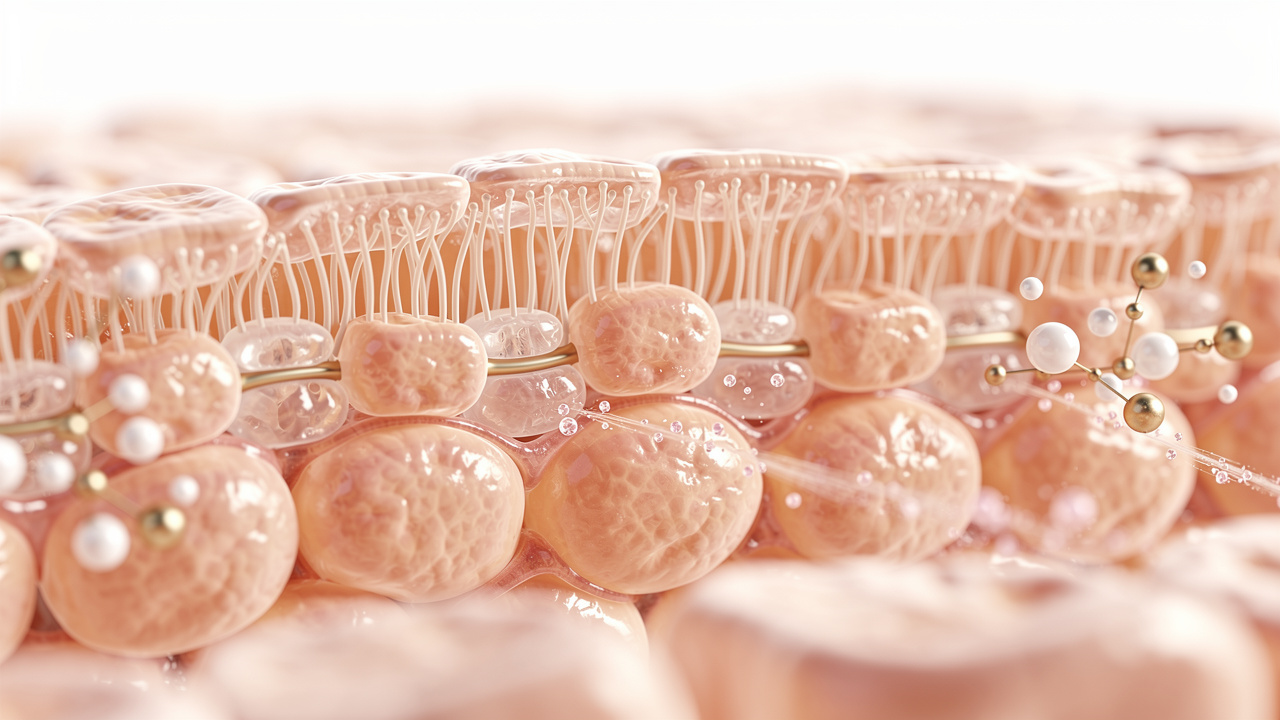
First-pass metabolism describes the early processing of compounds as they move from the gut to the bloodstream. For ginger phenolics, this path runs through two main systems. The first is the intestinal wall. The second is the liver. Both contain enzymes that change foreign molecules so the body can remove them.
Phase One metabolism comes first. Here, cytochrome P450 enzymes carry out reactions such as oxidation and reduction on gingerols and shogaols. Liver microsome studies from mice, rats, dogs, and humans all show that these compounds have high intrinsic clearance. In simple terms, they are favorite targets for these enzymes, and little species difference appears in this pattern.
Phase Two metabolism, however, plays the starring role for ginger. In this phase, the body attaches small, water‑loving groups to compounds. For gingerols and shogaols, glucuronidation dominates. Enzymes called uridine glucuronosyl transferases, or UGTs, attach a glucuronic acid group to the phenolic structure. This change makes the molecule much more water soluble, which speeds up excretion through urine and bile.
The strength of this process becomes very clear when researchers treat blood samples with β‑glucuronidase, an enzyme that breaks the bond between the ginger compound and the glucuronic acid. In animal work with oral ginger extract, free 6‑gingerol levels jump three hundred sixty‑one times after this treatment, reflecting the metabolic stability patterns documented in pharmacokinetic studies. Free 8‑gingerol rises six hundred ninety‑eight times. Free 6‑shogaol climbs sixty‑six times. These huge shifts show that the main pool of ginger phenolics in blood sits in conjugated form.
From an evolutionary view, this makes sense. The body did not evolve to squeeze the most benefit from plant phenolics. It evolved to quickly neutralize and clear foreign chemicals. Rapid conjugation protects tissues from possible harm by limiting how long potent compounds can act. For ginger, that protective reflex has an unintended side effect for modern supplementation. It turns most standard ginger extract for absorption into inactive conjugates before the active form can do much.
Over time, data on time to peak concentration, or Tmax, adds another layer. In many studies, conjugated forms reach peak levels in plasma very quickly, often within thirty minutes, and often earlier than the free forms. This timing confirms that metabolism tracks absorption very closely. Ginger phenolics do not linger in a free state for long once they cross the gut wall.
Pharmacokinetic Parameters: Interpreting The Data
Pharmacokinetics describes how compounds move through the body. Several simple measures help translate complex data on ginger extract for absorption into plain terms. Three of the most important are Cmax, Tmax, and AUC.
Cmax means the highest concentration a compound reaches in blood after a dose. In mouse work with oral ginger extract, free 6‑gingerol shows a Cmax of only 27.18 nanograms per milliliter. When researchers measure total 6‑gingerol after freeing it from conjugates, that number shifts to 12,473 nanograms per milliliter. The gap between those values shows how much sits hidden in metabolized form.
Tmax is the time it takes to reach that peak. For ginger phenolics this window is short. Many free forms reach their low peak within about thirty minutes. Conjugated forms often peak even faster, which means enzymes act on gingerols and shogaols almost as soon as they cross into the intestinal wall and enter the liver.
AUC, or area under the curve, sums up overall exposure over time. Free 10‑gingerol provides an AUC around 61.80 nanogram‑hour per milliliter in some mouse studies. Total 10‑gingerol, including conjugated forms, reaches 634.7 nanogram‑hour per milliliter. That ten‑fold rise matches what we see with other ginger phenolics.
Researchers have tested ways to slow this breakdown. In one example, they gave ketoconazole, a drug that inhibits some Phase One and some Phase Two enzymes, together with ginger extract. Free ginger phenolic exposure rose three to sixty times. Yet when β‑glucuronidase treatment came into play, large pools of conjugated forms still appeared. That outcome confirms that glucuronidation remains the main gatekeeper.
For a careful consumer, these numbers send a clear message. Any product that claims superior ginger extract for absorption but ignores first-pass metabolism is leaving most of the real challenge untouched.
Physicochemical Properties: Why Ginger Compounds Are Built For Oral Delivery
Given the low free levels in blood, it is easy to assume ginger phenolics might be unstable or hard to absorb. Physicochemical data tell a different story. On paper and in lab tests, 6‑gingerol, 8‑gingerol, 10‑gingerol, and 6‑shogaol look very suitable for oral intake.
As mentioned earlier, they fit well within the Lipinski Rule of Five and Veber’s rules. Their molecular weight sits under five hundred daltons, and their polar surface area stays below one hundred forty square angstroms. They do not carry an excessive number of hydrogen bond donors or acceptors. All of these traits favor passage across the lipid membranes that line the gut.
Solubility adds another angle. When tested at different pH levels that mimic stomach and intestinal conditions, 6‑gingerol and 8‑gingerol show high solubility above one hundred micromolar. 10‑gingerol and 6‑shogaol show lower solubility under ten micromolar, which leads to classification of ginger phenolics as Biopharmaceutics Drug Disposition Classification System (BDDCS) Class Two or Four compounds. In simple terms, some members of this group have low solubility, even though permeability itself is not deeply flawed.
Stability studies round out the picture. In simulated gastric fluid, all four key phenolics remain intact for at least one hour. In simulated intestinal fluid, they stay stable for at least two hours. That means stomach acid and digestive enzymes do not destroy them before they have a chance to cross the gut wall.
The central lesson here is simple. Sub‑therapeutic levels of free gingerols and shogaols in plasma do not arise because these molecules fall apart in the gut. They survive the trip through stomach and intestines. The problem appears later, when human detox systems step in. For formulators, this means that ginger extract for absorption cannot rely on solubility tweaks alone. Better solubility may increase how much enters the gut wall, yet without some form of metabolic support, the liver will still neutralize most of it.
The Health Benefits That Make Absorption Worth Optimizing
With so many barriers, it is fair to ask why we care about ginger extract for absorption at all, though clinical research on ginger root has established multiple therapeutic applications that justify the effort. The answer comes from a wide body of research on ginger’s benefits. When enough active compound reaches the right tissues, ginger can support several systems that matter for daily comfort and long‑term health.
-
Digestive support. Gingerol helps move food along the digestive tract at a steady pace. Faster stomach emptying can ease feelings of fullness, reduce pressure that leads to reflux, and support regular bowel habits. This is where the idea of ginger for digestion comes from, and the evidence supports that use.
-
Nausea relief. Clinical work shows benefit for morning sickness, motion sickness, and nausea linked to chemotherapy. The American College of Obstetricians and Gynecologists lists ginger as an acceptable non‑drug option for nausea during pregnancy. By calming the stomach and supporting smoother motility, ginger helps many people feel more stable.
-
Inflammation balance. With over four hundred natural compounds, ginger provides multiple signals that dial down inflammatory pathways. Gingerols and shogaols can dampen NF‑κB and related signaling cascades. This may help with conditions that involve chronic low‑grade inflammation, including joint discomfort and some metabolic issues, though more large human trials are still needed.
-
Antioxidant activity. Ginger phenolics can directly neutralize free radicals and support the body’s own antioxidant systems. Lower oxidative stress reduces damage to lipids, proteins, and DNA, which ties into healthier aging and lower risk for several chronic conditions.
All of these effects also feed into immune support and joint comfort. A body under less oxidative and inflammatory stress is better able to respond to infections and feels more mobile and less sore. For sleep, this matters more than many people realize. When pain, bloating, or reflux keep someone tossing and turning, no amount of melatonin can fully fix the problem. Ginger helps remove those physical barriers so the nervous system can settle.
This is where SLP1’s interest in ginger extract for absorption began. If more bioavailable ginger can ease discomfort and calm background inflammation in the evening, it supports the rest of a sleep formula by clearing the way for deep rest.
Advanced Strategies For Improving Ginger Extract Absorption
Once we know that metabolism, not gut breakdown, limits ginger, the obvious next step is to ask how to get more active compound into circulation. Over the past decade, scientists and advanced supplement brands such as SLP1 have explored several strategies to improve ginger extract for absorption.
One idea uses metabolic inhibitors. In research settings, drugs such as ketoconazole block certain cytochrome P450 and UGT enzymes. When given together with ginger extract in animal studies, they raise exposure to free gingerols and shogaols three to sixty times. This proves that slowing metabolism can raise active levels. Yet it is not a practical path for most people. Strong enzyme inhibitors carry their own risk profile and interact with many medications.
Another set of strategies focuses on solubility. Since 10‑gingerol and 6‑shogaol have lower solubility, formulators sometimes use co‑solvents, lipids, or emulsifiers to help these compounds dissolve better in the watery environment of the gut. Better dissolution can raise the absolute amount that reaches the intestinal wall. This is helpful, but it still leaves the first-pass metabolic wall in place.
The most promising direction has come from advanced delivery systems that shape how the body sees ginger from the start. Liposomal encapsulation, for example, places ginger extract inside tiny spheres made from phospholipids. These spheres can fuse with cell membranes and may protect ginger phenolics from some early enzymatic contact.
Nano‑particle designs take a different angle. They shrink ginger extract into particles between one and one hundred nanometers in size. At this small scale, particles behave differently in fluids and at cell membranes. They can dissolve faster, interact more strongly with the intestinal surface, and may use alternate uptake paths that bypass some enzyme‑rich sites.
In all of these approaches, the theme is the same. Amount on the label matters far less than how much reaches the bloodstream in active form. At SLP1, this focus shows up across the entire product line. Rather than rely on generic white‑label formulas, the team designs each ingredient around bioavailable forms and advanced delivery, including ginger. That is true for sleep support, where uses ginger in a way that supports both its own activity and the absorption of partner botanicals.
Nano-Particle Technology: The Next Generation Of Absorption Science
Nanotechnology sounds high‑tech, yet the basic idea is simple. Take a plant extract such as ginger and break it down into very small particles, often under one hundred nanometers in diameter. For comparison, many standard herbal powders contain particles many times larger than that.
Why does this matter for ginger extract for absorption? The gut does not work like a wide‑open pipe. Absorption takes place through tiny channels and cellular structures that sit in the intestinal wall. Many of these channels fall around two hundred nanometers in scale. When particles are much larger, they rely more on slow diffusion and partial breakdown before they can cross.
Nano‑sized ginger particles have three main advantages. First, they can take more direct routes into the body. Some can slip through tight junctions between cells or enter cells through endocytosis, a process where the cell membrane folds around a particle. This allows faster entry with less time spent in contact with metabolizing enzymes.
Second, shrinking particle size raises surface area. A single large particle has less total surface than the many nano‑particles created from it. More surface area means more contact with the aqueous environment of the gut and more opportunity for dissolution. That speeds up the process of getting ginger phenolics into a form the body can take up.
Third, the faster and more direct the uptake, the less window enzymes in the intestinal wall and liver have to modify the molecules. While nanotechnology does not switch off glucuronidation, it can shift the balance so that a higher fraction of gingerols and shogaols appear in blood in free form.
The outcome is dose efficiency. A lower milligram amount of nano‑particle ginger can produce plasma levels of active compounds that match or exceed much higher doses of conventional extract. This shift justifies the care and cost that go into nano‑formulation. It turns ginger extract for absorption from a marketing claim into a measurable change in pharmacokinetics.
These systems do require more advanced manufacturing and tight quality control. Particle size distribution must be verified, and stability over shelf life must be checked. Serious brands accept these demands because the payoff is real — less waste, more effect, and products that respect both the research and the biology.
Ginger In Synergistic Sleep Formulations: The SLP1 Approach

Sleep problems rarely come from a single cause. Pain, reflux, racing thoughts, late caffeine, bright light, and irregular schedules all feed in. SLP1 designed its Get to Sleep formula around that reality. The goal is not to knock someone out. The goal is to restore healthy rhythms so the body can fall asleep and stay asleep without dependence. Ginger plays a quiet yet important part in this design.
First, ginger acts as a physical barrier remover. Nighttime discomfort from joints, muscles, or digestion often keeps people awake even when their brains feel tired. By calming inflammation and supporting smoother digestion, ginger reduces that background noise. A person who does not feel bloated or sore can enter deep sleep stages more easily.
Second, ginger supports the broader absorption picture. When you think in terms of ginger extract for absorption, it is natural to also think about how the same strategies can help other ingredients in the same capsule. Advanced delivery systems and bioavailable forms chosen for ginger can be applied to other botanicals and nutrients in Stay Asleep. The result is a formula where each ingredient both acts on its target and helps the whole blend perform better.
Timing also matters. SLP1 builds its protocols around evening intake that aligns with natural circadian shifts. As the nervous system slows and body temperature begins to drop, the body is more ready to receive signals that support rest. Ginger taken in this window works alongside calming neurotransmitter support, blood sugar control support, and other sleep‑linked pathways.
All of this stays within a non‑sedating, long‑term strategy. Stay asleep does not force sleep through heavy sedatives. Instead, it layers signals that guide the body back toward its own pattern. In user data, this approach has led to an eighty‑five percent larger improvement in the ability to fall asleep, a ninety‑three percent larger rise in overall sleep quality, and a sixty‑four percent increase in the feeling of waking refreshed.
Those numbers do not come from ginger alone. Yet ginger’s role inside the formula shows how a smart, science‑based view of ginger extract for absorption can support more than digestion. It becomes part of a wider plan that respects biology, quality, and long‑term use.
Different Forms Of Ginger: A Comparative Analysis For Informed Consumers
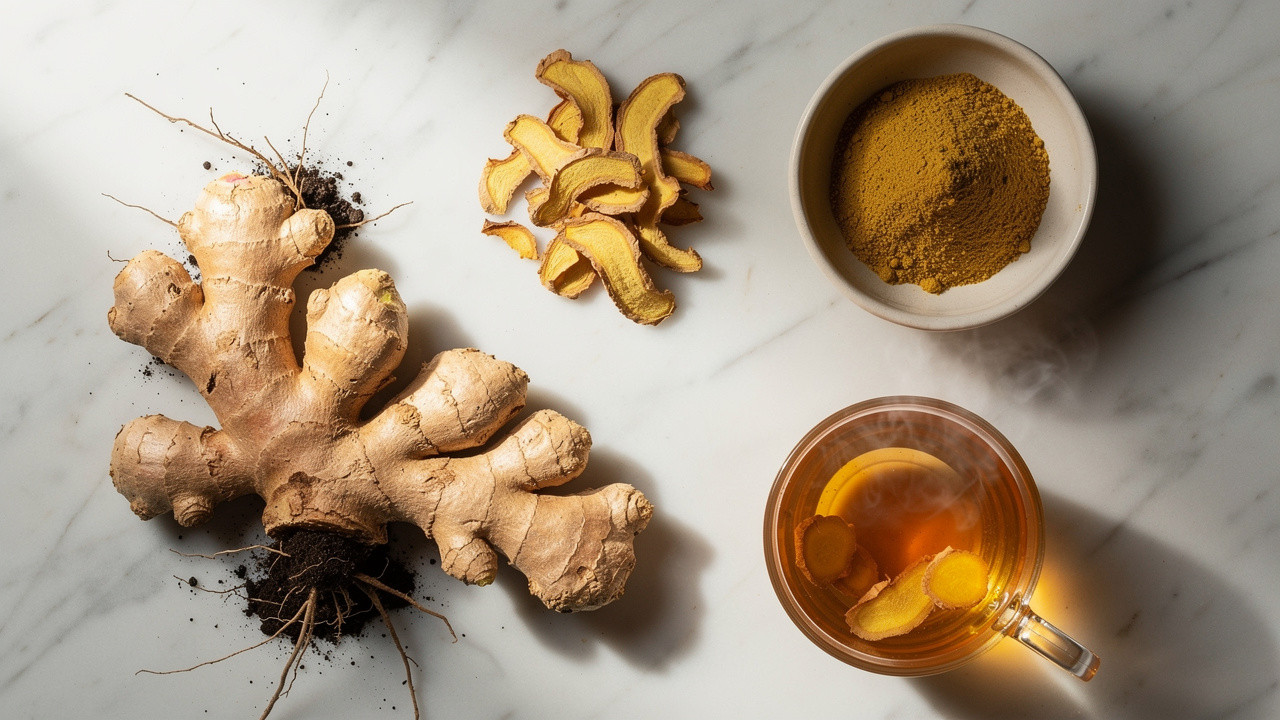
Not every person needs a high‑tech ginger supplement. Knowing the range of ginger forms helps match the right format to the right goal. Each option carries its own strengths and limits.
Fresh ginger root is the form most people know. It offers bright flavor and a strong hit of gingerols. Grated or sliced root in hot water makes a simple tea that supports digestion and warmth. Fresh root stores well in the refrigerator and can be peeled and frozen for later use.
Dry ginger powder is the pantry workhorse. Made from dried and ground root, it keeps for a long time and fits easily into recipes and smoothies. Drying shifts some gingerol into shogaol, which can raise certain bioactivities. The flavor profile is a bit different from fresh ginger, yet the health value remains strong.
Ginger paste in jars or tubes provides a shortcut for cooking. It saves preparation time but needs label reading, since some products include additives or oils that certain people may want to avoid. Proper storage in the refrigerator keeps it usable for weeks.
Ginger tea from commercial tea bags is another simple option. These products usually contain dried ginger alone or with other herbs. They are convenient at home and at work, although the amount of active compound per cup can vary. Pickled ginger, often seen with sushi, adds the benefits of fermentation with relatively modest sodium levels compared with other pickles.
Ginger supplements, usually capsules or softgels, sit at the other end of the spectrum. They aim to provide concentrated and standardized doses for specific health targets. This is where ginger extract for absorption and questions about bioavailability matter most. Institutions such as Johns Hopkins Medicine often suggest that, for general wellness, most people rely on dietary ginger first and use supplements for clear, targeted needs with high‑quality products.
The Quality Imperative: How To Identify Legitimate Ginger Supplements
The supplement market in the United States runs under a framework where companies are responsible for product safety, yet most products reach shelves without prior review for content or purity. That gap creates real variation in actual ingredient levels, contaminants, and label accuracy. For ginger and for any other supplement, clear quality markers help separate serious products from guesses.
Three key markers to look for are:
-
Third‑party testing. This means an independent lab, with no financial link to the brand, measures identity, potency, and purity. For ginger extract for absorption, that testing checks whether the claimed amount of ginger extract is present and whether the profile of gingerols and shogaols matches expectations. It also screens for heavy metals, microbes, and pesticides.
-
cGMP manufacturing. Production under current Good Manufacturing Practices (cGMP) keeps products consistent from lot to lot through documented procedures, clean environments, and batch records. FDA registration of the facility adds another layer of oversight and accountability.
-
Thoughtful formula design. Clean formulations avoid unnecessary fillers, artificial colors, flavors, and preservatives. They use non‑GMO ingredients when possible and plant‑based capsules for those who avoid gelatin. For people with celiac disease or gluten sensitivity, explicit gluten‑free status matters.
SLP1 treats these markers as a baseline rather than a selling point. Products like get to sleep combine third‑party testing, cGMP manufacturing, and clean formulas with a deeper focus on pharmacokinetics and synergy. Instead of chasing trends, the team asks how each ingredient, including ginger, behaves from mouth to metabolism. That perspective guides choices around standardized extracts and advanced delivery methods tuned for real ginger extract for absorption.
For consumers who research before buying, these details answer important questions. Am I paying for a label claim or for verified content? Does this company show its work through published testing? Does the design make sense in light of the science on first-pass metabolism? Clear yes answers to those questions carry more weight than any celebrity endorsement.
As many quality experts remind consumers, "Third‑party data is far more informative than front‑label promises."
Safety Considerations And Potential Interactions With Ginger Supplementation
For most people, the ginger used in cooking and tea is very safe. Millions consume it daily across many cultures. Yet concentrated supplements change the picture. The dose rises, and with it, certain risks and interactions become more important to consider.
One concern relates to bleeding risk. Ginger can lightly thin the blood by reducing platelet aggregation. In standard food amounts, this effect is not a problem. At high supplement doses, especially when combined with drugs like warfarin, aspirin, or clopidogrel, it could, in theory, raise bleeding tendency. Research is not fully settled, but caution is wise for anyone on blood thinners. Medical advice is important before adding a strong ginger product in that case.
Blood sugar control is another area under study. Some data suggest that larger quantities of ginger may lower fasting blood glucose or improve certain insulin measures. That could be welcome for some, yet it raises the possibility of additive effects with diabetes medications. People with diabetes can usually enjoy ginger in food without concern, yet strong supplements should be discussed with the treating clinician.
Ironically, very high doses of ginger can bother some stomachs. While moderate ginger intake soothes nausea for many, more is not always better. Some individuals report heartburn, loose stools, or general discomfort when they take large ginger capsules on an empty stomach.
SLP1 keeps these points in view while designing formulas. Deeper Sleep uses ginger at clinically informed levels placed inside clean, tested capsules. The aim is to support comfort and sleep without pushing into dose ranges that raise safety questions for the average user. Even so, SLP1 encourages people with chronic conditions or those on prescription drugs to speak with their healthcare provider before starting any new supplement. Clear labeling and transparent communication around dose and content help that conversation go smoothly.
FAQs About Ginger Extract And Absorption
What Is The Main Reason Ginger Extract Has Poor Bioavailability?
The main reason standard ginger extract shows poor bioavailability is extensive first-pass metabolism, especially Phase Two glucuronidation. After gingerols and shogaols cross the gut wall, UGT enzymes in the intestinal lining and liver attach glucuronic acid to them. This change turns active phenolics into water‑soluble conjugates that the body clears through urine and bile. When researchers free these conjugates in the lab with β‑glucuronidase, free gingerols jump ten to seven hundred times. That pattern proves that metabolism, not gut breakdown, is the key bottleneck for ginger extract for absorption.
How Does Nano-Particle Technology Improve Ginger Absorption?
Nano‑particle technology improves ginger extract for absorption by shrinking the extract into particles between one and one hundred nanometers. At this size, ginger can interact more closely with the intestinal surface and pass through small absorption channels that larger particles cannot use as well. The huge increase in surface area improves dissolution, and the faster uptake gives enzymes less time to convert gingerols and shogaols into inactive conjugates. As a result, higher levels of free, active compounds reach the bloodstream from a given dose, which raises therapeutic impact without raising capsule size.
Is Fresh Ginger Better Than Ginger Supplements?
Fresh ginger and ginger supplements serve different purposes rather than fitting into a simple better or worse ranking. Fresh root works very well for general wellness, cooking, and daily digestive comfort, especially as tea or in meals. High‑quality supplements provide concentrated, standardized amounts useful for specific goals, such as focused support for nausea or joint comfort, or as part of advanced sleep formulas. For supplements, absorption design and quality testing matter far more than raw dose. Many medical centers suggest food sources first and reserve supplements for needs where a targeted, well‑tested product makes sense.
What Should I Look For When Choosing A Ginger Supplement?
A good ginger supplement starts with three firm quality markers. Third‑party testing shows that an independent lab has confirmed identity, potency, and purity, and has checked for heavy metals, microbes, and pesticides. cGMP manufacturing in an FDA‑registered facility shows that the product comes from a controlled process rather than a random packing line. Clean formulation means no unnecessary fillers or artificial colors and a clear non‑GMO, gluten‑free, and often vegan status. Beyond those basics, look for standardized gingerol and shogaol content and clear discussion of how the product approaches ginger extract for absorption, such as liposomal or nano‑particle design, rather than vague marketing phrases.
Can Ginger Interact With Medications?
Yes, ginger at high supplemental doses can interact with certain medications. The most notable concern involves blood thinners and anti‑platelet drugs, where ginger’s mild blood‑thinning effect could add to medication impact and raise bleeding risk. Another area of possible interaction is with diabetes drugs, since larger ginger doses might lower blood sugar further. Normal food use of ginger is generally safe for people on these medications. Even so, anyone taking prescription drugs, especially those that affect clotting or glucose, should talk with a healthcare provider before adding strong ginger supplements or products that focus on powerful ginger extract for absorption.
Conclusion
Ginger offers a strong set of scientifically supported benefits — from smoother digestion and less nausea to calmer inflammation and better joint comfort. The challenge has never been a lack of promising data. The challenge has been getting enough of ginger’s active compounds into the bloodstream in free, usable form. Research showing ten to seven hundred times more gingerols and shogaols in conjugated form than in free form makes the scale of this problem very clear.
For anyone who cares about evidence‑based wellness, this means ingredient lists and raw milligram counts are not enough. The real question is how a product deals with absorption and first-pass metabolism. Advanced delivery systems such as liposomal carriers and nano‑particle formats move ginger extract for absorption from a claim to a measurable shift in pharmacokinetics. At the same time, third‑party testing, cGMP facilities, and clean formulas set the baseline for safety and trust.
SLP1’s formula shows what this thinking looks like in practice. Ginger supports the formula by easing physical discomfort that blocks rest and by fitting into an absorption‑focused design alongside other botanicals. The result is not a quick sedative but a rhythm‑focused approach that has delivered large gains in sleep onset, sleep quality, and morning refreshment for users.
In the end, effective supplementation is less about taking more and more capsules and more about helping the body use what it receives. When absorption and metabolism are part of the design from the first step, ingredients such as ginger can live up to their research. That is the standard SLP1 aims for — products built around how the body actually works, so natural compounds can do the work they are meant to do.

Leave a comment
This site is protected by hCaptcha and the hCaptcha Privacy Policy and Terms of Service apply.