Introduction
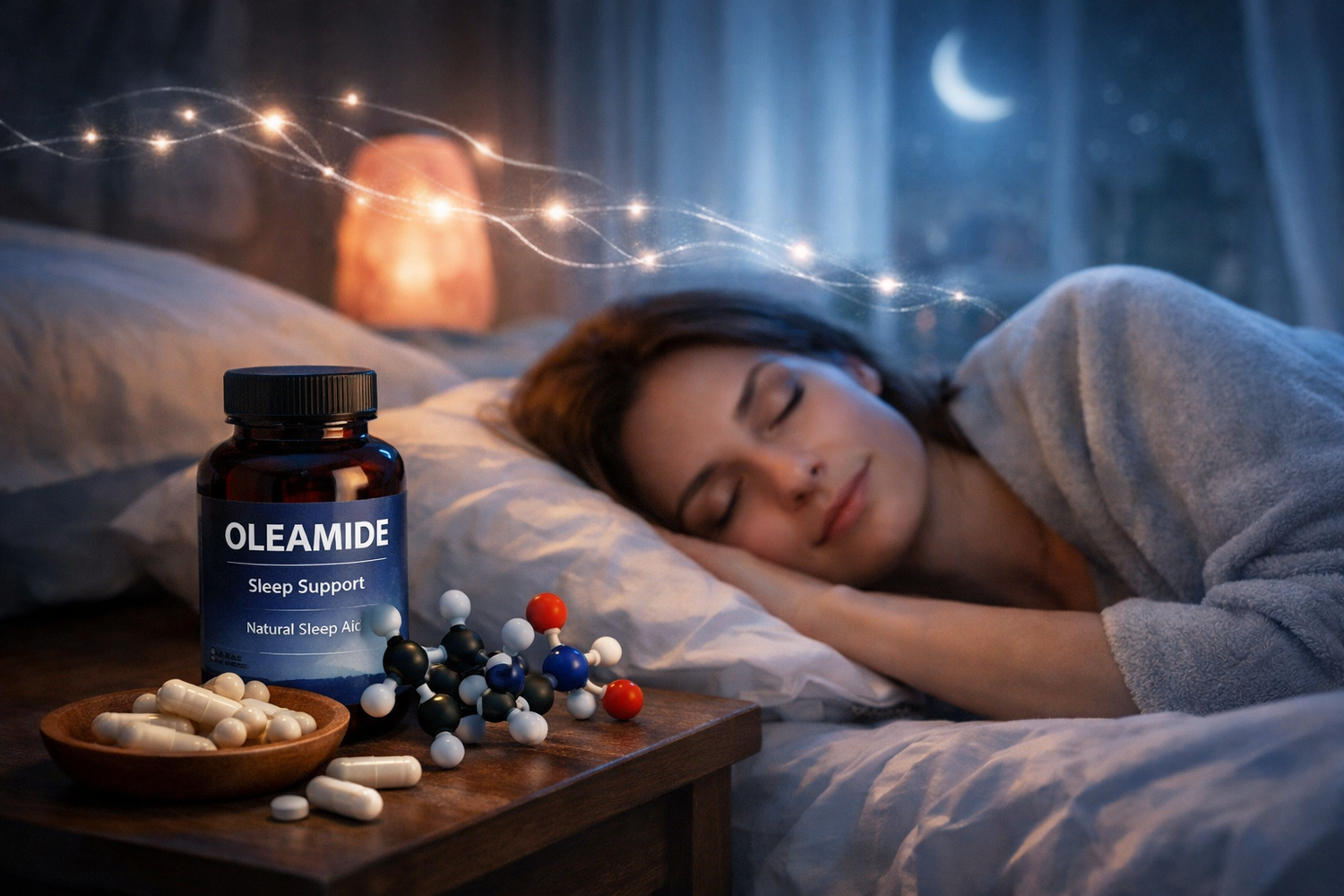
Picture the brain as a dimmer switch instead of an on‑off button. During a long day, tiny signals slowly turn that dimmer toward rest, and by night the room wants to go dark. One of the most interesting of those signals is oleamide for sleep – a fatty molecule the brain makes on its own that seems to tell the body, “It is time to shut down gently.”
Oleamide came to light when scientists examined the fluid around the brain of sleep‑deprived animals and found a mysterious substance that made other animals fall asleep faster. That compound, now called oleamide, is not a drug from outside; it is part of the brain’s own chemistry. Instead of forcing deep sedation the way many pills do, oleamide appears to strengthen existing sleep pathways and ease the shift from wake to rest.
Interest in oleamide for sleep has grown as more people look for natural, science‑backed options that match how the body already works. Health‑conscious professionals, biohackers, and careful supplement users want better sleep and better next‑day performance, but they do not want dependency, morning fog, or guesswork. By the end of this article, you will see how oleamide works across multiple brain systems, what animal research shows, how SLP1 Protocol uses it inside thoughtful sleep protocols, and how it can fit into a larger, long‑term sleep strategy.
“If sleep does not serve an absolutely vital function, then it is the biggest mistake the evolutionary process ever made.” — Allan Rechtschaffen, sleep researcher
Key Takeaways
-
Oleamide is an endogenous fatty compound tied to the sleep–wake cycle. Its levels rise with extended wakefulness, which lines up well with the idea of growing sleep pressure through the day. This makes oleamide very different from an outside sedative that forces the brain down regardless of internal timing.
-
Animal studies link higher oleamide to deeper, more restorative sleep. In sleep‑deprived animals, oleamide in the fluid around the brain rises several fold, and when scientists give extra oleamide it shortens the time to fall asleep. The strongest changes show up in non‑REM sleep, which is the deeper and more physically restorative phase.
-
Oleamide acts across several brain systems. It modulates the endocannabinoid, GABA, and serotonin systems, mostly as an allosteric helper rather than a direct on‑off trigger. That multi‑system action seems to support a natural sleep pattern instead of blunt sedation that disrupts normal sleep architecture.
-
FAAH, a key enzyme, controls oleamide levels. This enzyme breaks down both oleamide and the endocannabinoid anandamide. When researchers block FAAH in animals, sleep onset speeds up and total sleep time rises, which strongly supports oleamide’s role as a real sleep‑regulating signal.
-
SLP1 uses oleamide inside in‑house sleep formulas such as Get to Sleep and Deeper Sleep, with dosing, delivery form, and partner ingredients chosen to work with natural biology. The aim is not a quick knockout but steadier, compounding support for the brain’s own sleep signals over time.
What Is Oleamide? Understanding Your Brain's Natural Sleep Signal

Oleamide, also called cis‑9,10‑octadecenamide, is a fatty acid amide that the body makes on its own. Chemically, it is an 18‑carbon chain with a single cis double bond and an amide group at one end. That shape places it in a family of signaling lipids that influence how nerve cells fire and talk to each other.
The first big clue about oleamide’s role in sleep came from classic experiments in cats. Researchers collected cerebrospinal fluid (CSF) from animals kept awake for long periods and found a lipid they nicknamed “cerebrodiene.” When they gave this lipid to other animals, it brought on behavioral and brain‑wave signs of normal sleep, not drugged stupefaction. Later, detailed chemistry work showed that cerebrodiene and oleamide were the same thing.
Further studies in rats found that oleamide levels in CSF rise more than threefold after about six hours of sleep loss. That kind of time‑linked build‑up is exactly what sleep scientists have long expected from a home‑grown sleep signal. The brain seems to run its own internal “pharmacy,” and oleamide is one of the compounds on the shelf that shows up more and more the longer someone stays awake.
Oleamide stands out among fatty molecules because it is very potent at the tiny concentrations seen in real tissue, typically in the 10⁻⁹ to 10⁻⁷ molar range. Free fatty acids often need far higher levels to cause similar effects on ion channels. Oleamide’s structure is also related to other important lipids such as sphingosine and sphinganine, which already play key roles in membranes and signaling. All of this places oleamide firmly in the category of true signaling molecules rather than passive structural fats.
How Oleamide Accumulates During Wakefulness And The Sleep Pressure Connection

Most people know the feeling of rising sleep pressure. Early in the day, it is easy to push through tasks. After a long stretch of time awake, eyelids feel heavy and focus slips. Oleamide appears to track that build‑up at a molecular level.
In rat studies, researchers measured oleamide in cerebrospinal fluid after controlled sleep deprivation. Compared with rested animals, those kept awake for six hours had more than three times the level of oleamide in their CSF. Since CSF bathes the brain and spinal cord, that rise shows that neural tissue sits in a steadily higher bath of this sleep‑related molecule as wake time stretches out.
This pattern fits the concept of homeostatic sleep pressure. The longer the brain stays in an active state, the more certain signals build up that push the system toward rest. With oleamide for sleep, that pressure does not rush in all at once. It slowly collects, which lines up with subjective experience: mild drowsiness becomes strong sleepiness as the night wears on.
There is an important contrast here with pharmaceutical sleep aids. Many sleeping pills hit a receptor very hard within a short time window, overriding whatever natural level of sleep pressure the body has reached. Oleamide’s gradual accumulation instead looks like an internal meter that the brain reads to decide when to shift from wakefulness to sleep. That biological logic helps explain why scientists see oleamide as a genuine sleep regulator, not just a sedating chemical.
The Multi-System Mechanism How Oleamide Promotes Sleep Across Multiple Pathways

One of the most interesting aspects of oleamide for sleep is how many systems it touches at once. Instead of locking onto a single receptor the way many drugs do, oleamide acts more like a conductor who guides several sections of an orchestra, as demonstrated in research on the hypnotic actions of the fatty acid amide across multiple neurotransmitter systems. The “strings” might be the endocannabinoid system, the “woodwinds” GABA, and the “brass” serotonin. Together they create a full sleep symphony.
At the receptor level, oleamide usually does not sit in the main binding pocket. It often acts at allosteric sites, which are side spots on the receptor that change how the main site responds. That kind of modulation tends to support natural patterns rather than force them. There is also evidence that oleamide may shift phosphorylation states through protein kinases, which work like molecular light switches that change receptor sensitivity.
Equally important is what oleamide does not do. Tests show little to no direct effect on many other big receptor classes, such as muscarinic, metabotropic glutamate, NMDA, or AMPA receptors. That selectivity suggests a focused, sleep‑skewed profile instead of global dulling of brain activity. For careful users, this is part of the appeal: multi‑pathway action, but still targeted.
SLP1’s sleep formulas are built with this same “orchestra” mindset. Instead of chasing a single trendy receptor, SLP1 designs in‑house blends that support several natural pathways at once, with oleamide as one key part of that layered support.
The Cannabinergic Connection And Your Body's Natural Calming System
The endocannabinoid system acts as one of the brain’s main calming networks. It includes CB1 receptors in the brain, CB2 receptors in immune cells, and internal ligands such as anandamide. Many people know about plant cannabinoids, but the body’s own endocannabinoids are just as important for mood, stress, and sleep.
Oleamide does not latch onto CB1 receptors the way THC does. Instead, it seems to make the body’s own anandamide signal last longer and act more strongly. Both anandamide and oleamide are broken down by the same enzyme, FAAH. When there is more oleamide around, it competes for FAAH and slows the breakdown of anandamide. Some data also suggest that oleamide may interfere with anandamide uptake into cells, which would raise its outside level even further.
The strongest proof that CB1 signaling matters for oleamide’s sleep effects comes from antagonist experiments. When researchers gave animals oleamide for sleep along with SR 141716, a selective CB1 blocker, the usual shortening of sleep latency disappeared. In practical terms, that means a working CB1 pathway is necessary for oleamide to deliver its sleep‑supporting effect. For people who want calmer thoughts at night without a psychoactive high, this indirect support of internal cannabinoid tone is especially appealing.
GABAergic Modulation And Your Brain's Primary Inhibitory Signal
GABA is the main inhibitory neurotransmitter in the brain. When GABA binds to GABA‑A receptors, chloride ions flow into neurons and make them less likely to fire. Many common sleep medications, including benzodiazepines, act on this system by increasing GABA’s effect.
Oleamide interacts with GABA‑A receptors, but not at the classic GABA or benzodiazepine sites. It behaves as a positive allosteric modulator at low concentrations, meaning it makes the receptor respond more strongly to the same amount of GABA. Experiments show that oleamide can increase the size of the chloride current that GABA triggers, which deepens overall inhibition across neural networks. At very high levels, this effect can flip and start to dampen the current, so the dose window matters.
One striking finding is the synergy between oleamide and drugs like triazolam in animals. Doses of each that are too low to cause sleep on their own can, when combined, bring on marked hypnotic effects. That pattern shows that oleamide’s GABA support is not just a lab curiosity. It has real‑world functional impact on the circuits that guide sleep onset and maintenance, in a way that acts more like a volume knob than an on‑off switch.
Serotonergic Pathway Support Fine-Tuning Mood And Sleep Regulation
serotonin plays a complex role in the sleep–wake cycle and in mood. Different receptor subtypes have different, sometimes opposite, effects. Oleamide interacts most clearly with the 5‑HT2A and 5‑HT2C receptors, which sit at important nodes in mood and sleep regulation.
At low, physiologically realistic concentrations around 200 nanomolar, oleamide boosts the currents that serotonin triggers through these receptors. Again, this happens without direct competition at the main serotonin binding site. The receptors simply respond more strongly when serotonin is present, which is a classic sign of allosteric modulation.
Researchers are still mapping exactly how much this serotonergic support contributes to sleep depth or dream patterns. However, the link between oleamide, serotonin receptors, and research on omega‑3 fatty acids and depression hints at wider mental health relevance. For people who see sleep as one pillar of emotional balance, this added layer of activity makes oleamide even more interesting.
The FAAH Enzyme Your Body's Natural Oleamide Regulator
For any signaling molecule, the “off switch” matters as much as the “on switch.” In the case of oleamide for sleep, the main off switch is the enzyme Fatty Acid Amide Hydrolase (FAAH). FAAH sits in cell membranes and breaks oleamide down into oleic acid and ammonia, which ends its signaling role.
FAAH is distributed widely across brain regions, which matches the broad influence of oleamide and related compounds. It does not only act on oleamide. Anandamide, the most famous endocannabinoid, also relies on FAAH for breakdown. That shared enzyme sets up a natural form of cross‑talk between sleep pressure and stress‑relief pathways, because shifts in one substrate can influence the other.
Animal studies that use FAAH inhibitors give a strong sense of how powerful this regulation is. When researchers block FAAH with compounds such as LOH‑1‑151 or 2‑octyl gamma‑bromoacetoacetate, animals fall asleep faster and sleep longer, even without giving extra oleamide. That happens because the body’s own oleamide and anandamide now survive longer before breakdown. This is one reason many scientists see FAAH, not oleamide itself, as a major future drug target.
SLP1’s product design keeps this enzymatic layer in mind. Instead of just adding a large amount of oleamide, SLP1 focuses on amounts that sit in research‑backed ranges and on partner ingredients that respect the body’s own regulatory systems, including enzymes like FAAH.
Evidence From Animal Studies What Research Tells Us About Oleamide's Sleep Benefits
While there is still limited human data, controlled animal experiments give a detailed picture of how oleamide for sleep behaves. These studies use clear outcome measures such as electroencephalogram (EEG) patterns, sleep latency, and time spent in different sleep stages.
In rats, scientists delivered very small amounts of oleamide directly into the brain’s ventricles. Doses around 2.8 to 5.6 micrograms during the day shortened the time it took animals to fall asleep according to EEG readings, consistent with research documenting the effect of oleamide on choline acetyltransferase in sleep-deprived animals. Total sleep time did not rise much, which likely reflects rapid breakdown by FAAH in brain tissue.
In mice, researchers used intraperitoneal injection at about 10 mg per kilogram, which sends oleamide through the body first. That approach both reduced sleep latency and raised total sleep time, mostly by increasing non‑REM sleep. REM sleep stayed about the same. This pattern points toward deeper, more restorative sleep rather than just more minutes in bed.
FAAH inhibitor studies add a final piece. By blocking oleamide breakdown without giving any extra oleamide, these experiments still showed faster sleep onset and longer sleep in both rats and mice. That strengthens the case that oleamide is part of baseline sleep regulation, not just a foreign sedative.
|
Model |
Intervention |
Main Sleep Effects |
|---|---|---|
|
Rat |
Intraventricular oleamide (2.8–5.6 µg) |
Shorter sleep latency, little change in total time |
|
Mouse |
Intraperitoneal oleamide (10 mg/kg) |
Shorter latency, longer total sleep, more NREM |
|
Rat & Mouse |
FAAH inhibitors |
Shorter latency, longer sleep without extra oleamide |
These findings do not mean that a supplement will copy every lab effect in humans. They do, however, give strong support for the core idea that raising oleamide signaling pushes the brain toward natural, physiologic sleep.
Oleamide vs Conventional Sleep Aids A Different Approach To Rest
Conventional sleep medications often focus on one main target. Many attach to GABA‑A receptors at the benzodiazepine site. Others use antihistamine action or high‑dose melatonin. These choices can knock a person out, but they can also lead to morning grogginess, tolerance, and disruption of normal sleep architecture.
Oleamide for sleep sits on the other side of that spectrum. Because it is an endogenous molecule, it tends to support existing sleep pathways rather than override them. Instead of forcing unconsciousness at a set clock time, oleamide amplifies the signals that already build during wakefulness, especially through endocannabinoid, GABA, and serotonin systems.
This different philosophy has several practical implications:
-
Lower risk of dependency in models, since the body already knows how to make and clear oleamide.
-
Better alignment with circadian rhythms, by working with internal timing and homeostatic pressure instead of ignoring them.
-
Greater receptor selectivity, with less broad impact on unrelated receptor systems and a cleaner side‑effect profile in animal work.
None of this means oleamide should replace medical treatment or that all pharmaceutical aids are bad. It simply offers another path: support for the body’s own signals instead of symptom suppression alone. SLP1’s melatonin‑free formulas lean into this idea by aiming for consistent, gentle support of internal sleep chemistry rather than a nightly “hammer.”
SLP1's Approach Incorporating Oleamide Into Science-Backed Sleep Formulations
SLP1 does not treat oleamide as a stand‑alone magic bullet. Instead, it places oleamide inside a broader sleep protocol that respects how the brain moves through night phases. Two key formulas, Get to Sleep and Deeper Sleep, each use oleamide in a specific context, and a third product, Stay Sleep, rounds out the three‑part SLP1 Protocol.
-
Get to Sleep focuses on easing the transition from active evening brain to a calmer pre‑sleep state. Here, oleamide pairs with calming nutrients to help quiet mental chatter and support natural GABA and endocannabinoid activity.
-
Deeper Sleep leans more toward depth and continuity, with oleamide seated alongside ingredients such as glycine, reishi mushroom, and magnesium to reinforce deep stages of sleep.
-
Stay Sleep aims at middle‑of‑the‑night resilience and a smoother wake phase.
Behind these products sits the SLP1 Quality Standard, which guides every formula:
-
Rigorous sourcing and formulation precision mean each lot of oleamide and every partner ingredient meets strict identity and purity checks. Formulas are not white‑labeled blends but in‑house designs shaped around research and long‑term use.
-
Clean label commitment means no common allergens, synthetic colors, artificial flavors, or empty fillers. For people who already eat carefully and read labels, this keeps the sleep stack aligned with the rest of their health choices.
-
Clinically relevant dosing aims for the middle ground between too little to matter and megadoses that push far beyond normal physiology. With oleamide for sleep, that means amounts guided by the animal data and by pharmacokinetics, not by marketing claims.
-
Advanced, bioavailable forms of key nutrients support absorption and steady blood levels. For oleamide and its partners, that may involve forms with better solubility or pairing with carriers that support passage across cell membranes.
-
Third‑party testing for potency and contaminants gives outside confirmation that what appears on the label matches what sits in the capsule, and that heavy metals and other contaminants stay below strict limits.
-
Melatonin‑free design respects the body’s own melatonin rhythm. Instead of flooding the system with large external doses, SLP1 supports the pathways that help the pineal gland keep its own timing.
The result is a protocol that uses oleamide as one part of a coordinated system, suited for people who view sleep as a long‑term investment investment, not just a crisis to put out once in a while.
Beyond Sleep Other Biological Activities Of Oleamide
Although sleep sits at the center of oleamide research, this molecule shows other important activities as well. One of the best described is its effect on gap junctions, which are tiny channels that connect neighboring cells. Gap junctions allow ions and small molecules to pass directly from cell to cell, which helps coordinate activity in tissues such as heart muscle and brain networks.
Oleamide can block this kind of intercellular communication at specific concentrations. Detailed structure–activity studies show that very small changes in the oleamide molecule can weaken or remove this gap junction effect, which underlines how tightly its structure links to its functions. In the nervous system, changes in gap junction communication may influence network synchronization and possibly how brain rhythms arise.
There are also hints that oleamide acts in the cardiovascular system, although that area is less defined. Reviews mention roles in blood vessel tone and heart function, which fits with its status as a signaling lipid rather than a simple structural fat. Because FAAH also breaks down oleamide in non‑brain tissues, this enzyme might be a wider regulator of both neural and cardiovascular signaling.
For readers focused mainly on sleep, these extra roles matter for one main reason: they remind us that oleamide belongs to a broader class of signaling lipids with wide‑ranging effects. Respect for that complexity is one reason SLP1 favors steady, physiologic support instead of aggressive, short‑term pushes.
Practical Considerations Using Oleamide For Sleep Support
Animal research provides signposts but not precise human doses. Studies in rats and mice use milligram‑per‑kilogram ranges that cannot be translated directly to people. Any responsible use of oleamide for sleep starts with modest amounts inside formulas that also support broader sleep hygiene.
Timing matters. Because oleamide levels in animals rise with hours awake, most people who use supplements aim for evening intake, roughly 30 to 90 minutes before bed. That window allows absorption and entry into the brain at the time natural sleep pressure would already be climbing. Some users report that higher doses can cause vivid dreams or mild morning heaviness, which points again to the need for careful titration.
A simple, cautious approach is:
-
Start low. Begin at the lower end of any suggested range.
-
Hold steady. Stay there for at least a week or two before making changes.
-
Observe carefully. Track time to fall asleep, night awakenings, and morning clarity in a simple journal or app.
It is wise to start on the lower end of any suggested range and stay there for at least a week or two before adjustment. This gives the nervous system time to settle into a new pattern and makes it easier to notice any subtle changes in sleep onset, night awakenings, or morning clarity. Because oleamide acts through GABA and endocannabinoid systems, people who take other sedative medications should speak with a clinician before adding anything that might add more inhibition.
No supplement can replace basic sleep habits. Helpful foundations include:
-
A cool, dark bedroom
-
Consistent bed and wake times
-
Limited caffeine after midday
-
A digital “sunset” at least an hour before bed
SLP1’s clinically dosed formulas with oleamide are designed to sit on top of those foundations, not to excuse their absence.
The Science Of Structural Specificity Why Oleamide's Exact Structure Matters
In pharmacology, shape is destiny. Molecules with small structural differences can behave very differently in the body. Oleamide is a textbook example of this rule.
Its structure includes an 18‑carbon chain with a single cis double bond between carbons 9 and 10, plus a primary amide. That specific layout fits the binding pockets and allosteric sites on certain receptors and channels in a way that other similar molecules do not. When researchers tested amides made from omega‑3 fatty acids, which have more double bonds and a different pattern, those compounds often showed only 40 to 60 percent of oleamide’s ability to modulate serotonin receptors.
This drop in potency from fairly small structural shifts shows that oleamide is not just “any” fatty acid amide. The length, the position and geometry of the double bond, and the amide head group all combine into a shape that key proteins can recognize. Change the length or move the double bond and the effect on receptors and gap junctions falls off sharply.
From a design standpoint, that precision matters. It suggests that copying oleamide loosely may not give the same sleep support. It also strengthens the case that the body settled on this exact molecule because it does a very specific job in the nervous system.
Oleamide In The Modern World Industrial Use And Environmental Considerations
Interestingly, oleamide is not only a brain signal. Industry uses it as a slip agent in polyolefin plastics. Manufacturers add small amounts of oleamide to films and molded parts to reduce friction and make them easier to process and handle.
Because oleamide is not covalently bound to the plastic, it can migrate to the surface over time. From there, it can transfer to anything that touches the material, including food in bags or containers that use this kind of plastic. Lab studies with simulated stomach and intestinal fluids suggest that any oleamide that leaches into food can survive at least part of its passage through the gut.
This raises understandable questions. If oleamide for sleep is a potent signaling molecule, what does chronic, low‑level exposure from packaging mean? At present, there is no clear evidence that this background exposure causes harm at typical intake levels, and doses from packaging are likely far below those used in supplements or research. Still, the overlap between a sleep‑active lipid and a common plastic additive shows how chemistry, consumer products, and physiology can intersect in surprising ways.
For careful consumers, the main takeaway is simple perspective. Intentional, well‑characterized intake through a clean, tested supplement such as those from SLP1 is very different from unmeasured background exposure from food contact materials.
Future Research Directions Oleamide's Therapeutic Potential
Scientists see oleamide as a template for a new class of sleep‑supporting medications. One path involves creating stable analogs of oleamide that resist rapid breakdown but keep its multi‑system action and favorable sleep architecture. Another path focuses on FAAH inhibitors, which raise endogenous oleamide and anandamide without giving extra lipid from outside.
FAAH inhibition has several theoretical advantages. Because it boosts the signals the body already makes in response to wakefulness and stress, it may produce a more natural time course of effect. It can also raise multiple helpful compounds at once, which might support both sleep depth and emotional balance. Of course, long‑term safety, off‑target effects, and individual differences in enzyme levels all need careful study.
Research on oleamide also overlaps with work on depression and anxiety. Omega‑3 fatty acids appear to influence serotonin receptors and mood, and oleamide is an especially strong modulator of some of those same receptors. A better map of how lipid amides shape serotonin signaling could guide future antidepressant or anxiolytic designs that act outside the classic monoamine reuptake model.
There are even early discussions about respiratory stability and possible use in conditions such as sleep apnea, though this remains speculative. As with any new class of compounds, proper human trials, dose‑finding studies, and long‑term follow‑up will take time. For now, oleamide stands as a bridge between basic lipid neuroscience and practical sleep support.
Integrating Oleamide Support Into A Comprehensive Sleep Strategy

Even the best single ingredient cannot replace a system‑level approach to sleep. Oleamide for sleep seems to work best when it becomes part of a broader plan that respects circadian rhythms, nervous system balance, and daily habits.
Foundational steps matter first:
-
Consistent bed and wake times to anchor the body clock
-
Morning light exposure to help reset that clock each day
-
A cool, dark, quiet bedroom to signal the nervous system that night has arrived
-
Caffeine cutoffs by early afternoon and lighter evening meals to reduce signals that clash with rest
On top of those basics, targeted nutrients and botanicals can support specific aspects of sleep physiology. Magnesium and glycine may support relaxation in muscles and the brain. Reishi mushroom and L‑theanine may help ease tension and mental overactivity. Within that larger context, oleamide adds direct support to the brain’s own sleep pressure and calming networks.
SLP1’s three‑part Protocol reflects this layered view. Get to Sleep focuses on winding down. Deeper Sleep targets depth and continuity. Stay Sleep supports a smooth night and a clear morning. Each stage uses oleamide and other ingredients in a way that lines up with the stage’s role.
“Sleep is the single most effective thing you can do to reset your brain and body health each day.” — Matthew Walker, PhD, neuroscientist and sleep researcher
A key mindset shift is to think in terms of months, not single nights. When people combine oleamide‑based support with steady habits, improvements in sleep quality often build gradually and then stabilize. This mirrors how the brain itself changes: little by little, through repeated patterns rather than through one‑time hacks.
Customer Experiences Real-World Reports Of Oleamide-Based Sleep Support

Real sleep is measured not just in lab graphs but in mornings that feel different. SLP1 users who have tried oleamide‑containing formulas often describe changes that are subtle at first and then increasingly obvious as weeks pass.
Consider the overworked professional in mid‑career who lies awake replaying meetings and email threads. Before SLP1, bed meant an hour of thinking in circles, followed by 3 a.m. awakenings and a heavy, unfocused start to the workday. After adding Get to Sleep in the evening as part of the SLP1 Protocol, this person reported that thought loops quieted more quickly. Nights still had stress, but the internal “volume” felt dialed down. Awakenings became less frequent, and when they happened, return to sleep came easier. Morning meetings felt sharper, even without extra coffee.
Across many reports, a few themes repeat:
-
People describe drifting off more easily, without the sharp “hit” that sedatives can cause.
-
They notice deeper, more continuous sleep with fewer long periods of staring at the ceiling.
-
Some mention more vivid dreaming, which may reflect changes in sleep architecture.
-
A common comment is a different kind of morning: less heavy‑eyed, more clear, and more ready to move into the day.
At the same time, responses vary. Some feel a change within days, while others notice a slow, quiet shift over several weeks. SLP1 is careful not to promise miracle nights. Instead, the aim is a steady return toward the brain’s own rhythm, supported by oleamide and companion ingredients. As always, individual results differ, and people with serious sleep or mood problems should work with a healthcare professional.
Conclusion
Oleamide stands out as one of the brain’s own sleep‑related signals. Its levels rise with time awake, and when researchers raise those levels further in animals, sleep comes faster and goes deeper, especially in non‑REM stages. Unlike many pharmaceutical aids, oleamide for sleep works across several pathways at once, including endocannabinoid, GABA, and serotonin systems, while leaving many other receptors alone.
This multi‑system, endogenous approach differs sharply from single‑target sedation. Rather than forcing unconsciousness, oleamide appears to support the brain’s natural decision to switch into sleep, in a way that respects circadian timing and homeostatic pressure. The FAAH enzyme adds another layer of control by deciding how long oleamide and anandamide remain active.
SLP1 builds on this science with in‑house formulas that place oleamide within a broader sleep protocol. The focus stays on clean ingredients, third‑party testing, melatonin‑free design, and realistic, long‑term support rather than quick fixes. When combined with solid sleep hygiene and a willingness to give the nervous system time to adapt, this approach offers a path toward steadier nights and clearer days.
Sleep science will keep moving forward, and oleamide research will likely uncover deeper connections to mood, cardiovascular health, and respiratory control. For now, understanding this quiet fatty amide can help any health‑conscious person make more informed choices about how to support the body’s own “gentle chemistry of rest.”
These statements have not been evaluated by the Food and Drug Administration. This product is not intended to diagnose, treat, cure, or prevent any disease.
Frequently Asked Questions About Oleamide For Sleep
This section gathers common questions about oleamide for sleep and offers science‑based, practical answers. It is for educational purposes only and does not replace medical advice.
Question How Is Oleamide Different From Melatonin For Sleep?
Melatonin and oleamide have very different jobs. Melatonin acts mainly as a timing signal from the pineal gland that tells the body when night has arrived. It lines up circadian rhythms with the light–dark cycle but does not directly create sleep pressure. Oleamide, by contrast, behaves more like a sleep‑drive signal that builds up with hours awake and nudges the brain toward actual sleep.
High‑dose melatonin supplements can, over time, dampen the body’s own melatonin production or shift circadian timing in ways that do not suit everyone. Oleamide for sleep does not replace an internal hormone. Instead, it modulates existing neurotransmitter systems, including the endocannabinoid, GABA, and serotonin pathways, in a way that rises with sleep debt. SLP1 favors this model of supporting endogenous processes rather than overwhelming them. In some cases, gentle circadian support and oleamide‑based sleep‑drive support may work side by side, but that synergistic sleep formulas should still be guided thoughtfully.
Question Can Oleamide Help With Racing Thoughts At Bedtime?
Racing thoughts often come from a nervous system that stays in “go” mode long after the day ends. Oleamide may help here by supporting both the endocannabinoid and GABA systems, which are central to mental calmness. By slowing the breakdown of anandamide and acting as a positive allosteric modulator at GABA‑A receptors, oleamide can make the brain more responsive to its own calming signals.
In real life, that may feel less like being knocked out and more like the mind losing its grip on constant replay. The overworked professional example from the SLP1 Protocol reflects this: meetings and to‑do lists still exist, but they stop looping quite so loudly once the lights go out. Effects often build over days to weeks, especially when paired with winding‑down habits such as dimmer lights and screens off. For severe anxiety or intrusive thoughts, though, oleamide is not a stand‑alone treatment, and a qualified clinician should be involved.
Question Is Oleamide Safe For Long-Term Use?
Safety with long‑term use depends on both the compound and the dose. Oleamide starts with an advantage because the body already produces it, and FAAH already knows how to break it down. That said, any time a person adds more of a signaling molecule from outside, dose and duration matter. Animal studies so far do not show dependency behavior tied to oleamide, which is encouraging.
SLP1 supports safety through strict sourcing, third‑party testing, and doses chosen to sit inside ranges suggested by research rather than far above them. The formulas also avoid melatonin, which sidesteps some of the long‑term concerns around external hormone use. Human data on many years of consistent oleamide use are still limited, so regular check‑ins with a sleep healthcare provider remain important, especially for people on other medications or with chronic conditions. As part of a well‑designed, comprehensive sleep plan, oleamide appears promising, but it should always be used thoughtfully.
Question How Long Does It Take For Oleamide To Work?
Timing can vary. Some people notice shorter time to fall asleep and fewer night‑time awakenings within the first several nights of using an oleamide‑containing formula. Because oleamide supports pathways that already exist, the brain does not need to grow new receptors before any effect appears. That allows for relatively fast changes in sleep onset for sensitive users.
Other benefits, such as consistently deeper non‑REM sleep and better morning clarity, often show up over a few weeks. The nervous system likes patterns, so steady use at the same time each evening tends to give better results than sporadic, crisis‑driven use. Compared with pharmaceutical sedatives that act within an hour but may leave heavy mornings, oleamide aims for a gentler curve: noticeable support in the short term and clearer stability in the longer term. A fair trial period is usually at least three to four weeks.
Question Can I Take Oleamide With Other Sleep Supplements?
Oleamide has real potential for synergy with other supportive nutrients. In lab studies, it worked together with GABAergic drugs so that each compound, at a low dose, produced stronger effects when combined. In the supplement world, ingredients such as magnesium, glycine for sleep, reishi mushroom, and L‑theanine often pair well with oleamide by acting on complementary aspects of the sleep process.
That said, stacking many separate sleep products on your own can raise the risk of excessive sedation or unexpected interactions, especially if prescription medications are also part of the picture. SLP1 addresses this by building multi‑ingredient formulas and protocols in‑house, so the combined effects are considered from the start. If a person wants to combine oleamide for sleep with other products not designed together, it is wise to add one thing at a time, at modest doses, and to discuss the plan with a healthcare professional.
Question Does Oleamide Cause Grogginess Or Next-Day Drowsiness?
Because oleamide supports physiological sleep instead of deep sedation, many users report less morning grogginess compared with standard sleep medications. When sleep architecture stays closer to normal, the brain’s own wake‑up processes can unfold more easily near morning. In SLP1 customer reports, a common theme is feeling clearer and more refreshed rather than thick‑headed.
That does not mean morning drowsiness never happens. Higher doses, individual sensitivity, or combining oleamide with multiple other calming agents can lead to a sense of heaviness on waking. More vivid dreaming, which some users notice, sometimes comes with a short period of grogginess if the alarm interrupts an intense dream. In those cases, lowering the dose, taking the product a bit earlier in the evening, or simplifying the overall stack often helps. The goal of oleamide‑based support is a night that feels deep and a morning that feels ready, not a trade‑off between the two.
These statements have not been evaluated by the Food and Drug Administration. This product is not intended to diagnose, treat, cure, or prevent any disease.


Leave a comment
This site is protected by hCaptcha and the hCaptcha Privacy Policy and Terms of Service apply.