Introduction
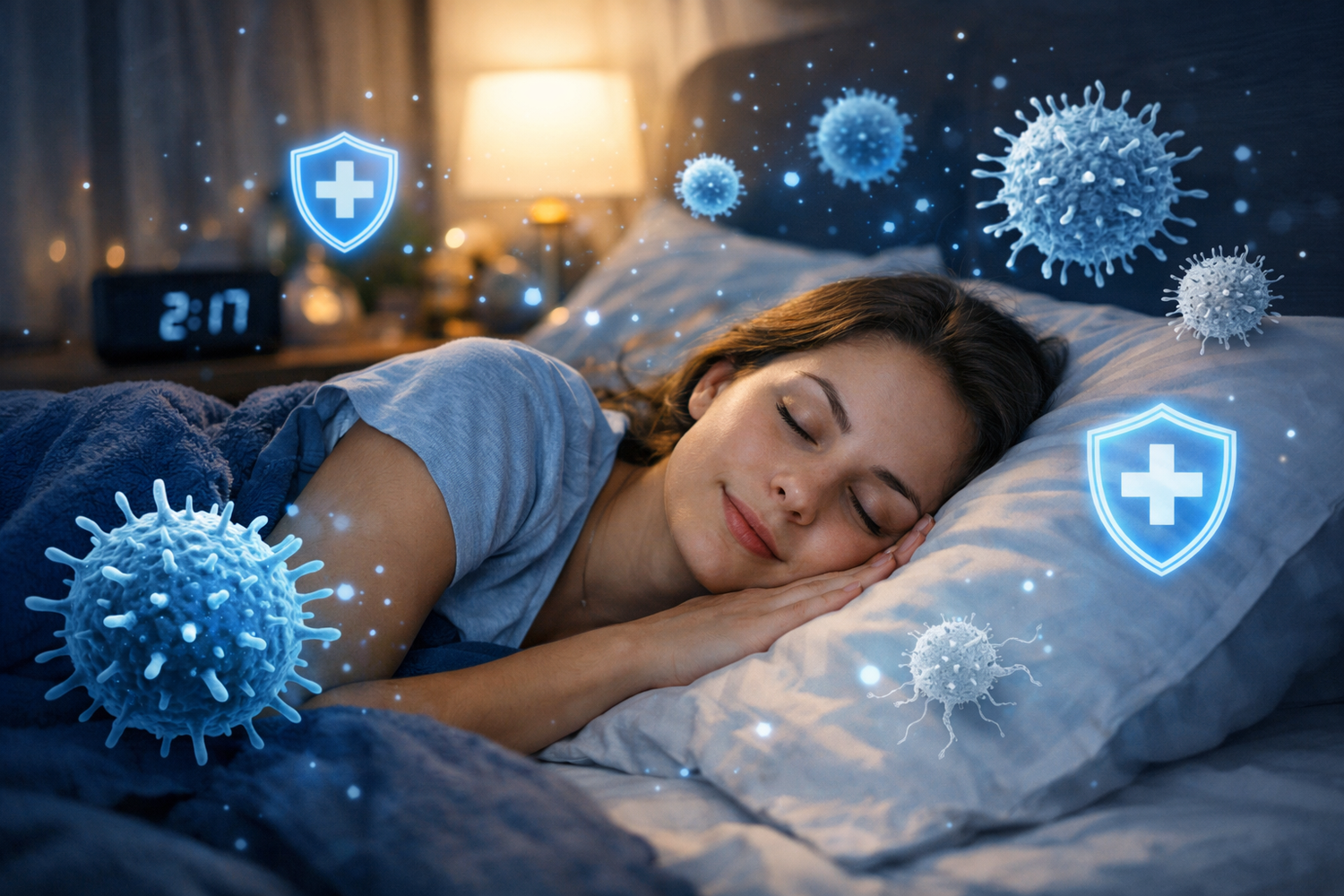
Most people think of sleep as the time nothing much happens. The mind powers down, the body rests, and the day resets. Under the surface though, sleep and immune function are working together in one of the busiest shifts the body runs.
During the hours when emails stop and lights go out, the immune system does some of its most advanced work. Research shows that sleep and immune function are tightly linked through both the sleep–wake cycle and the circadian rhythm. These two internal timekeepers help decide which immune cells are on duty, which signals fire, and when long term protection is built.
Instead of acting like a simple pause button, sleep creates a special hormonal and cellular setting. Deep sleep, also called slow wave sleep, shifts growth hormone, prolactin, and cortisol in a way that helps immune cells learn, move to the right tissues, and store memories of threats. This is one reason a single solid night after a vaccine can change immune responses for months.
“Sleep is the single most effective thing we can do to reset our brain and body health each day.” – Matthew Walker, PhD, author of Why We Sleep
This article walks through how the body times immune work across night and day, why slow wave sleep matters so much, how lack of sleep weakens defenses, and what studies on vaccines tell us about long term health. Along the way, it shows how SLP1 focuses on supporting natural sleep architecture, not just knocking someone out, so that sleep and immune function can work in sync for years rather than nights.
Key Takeaways
-
Sleep is an active immune event where cells move, signals change, and long term protection builds. Treating this window with care gives sleep and immune function room to work at their best.
-
Slow wave sleep, the deepest stage early in the night, supports immune consolidation and memory building in a way lighter sleep stages cannot match.
-
The hormonal setting of deep sleep, with high growth hormone and prolactin and low cortisol, behaves like a natural immune booster for long term defense.
-
Sleep loss disrupts IL‑12 signaling, T cell movement, and the strength of vaccine responses, which weakens how sleep and immune function work together.
-
Supporting natural sleep rhythms instead of heavy sedation is the most sustainable way to protect immune strength over decades, which is the core of SLP1’s design.
How Sleep And The Immune System Are Biologically Intertwined

The immune system does not run at the same level all day and night. It rises and falls on a schedule, and sleep and immune function share that schedule through two main forces. One is the sleep–wake cycle, which covers what happens when the body is actually asleep. The other is the circadian rhythm, the roughly twenty four hour clock that sets timing for many systems at once.
The circadian rhythm works like a master timetable. A small area in the brain called the suprachiasmatic nucleus responds to light and dark, then sends timing signals to hormones and organs. It tells hormones when to rise and fall and guides broad waves of immune cell movement across the day. On top of that, the sleep–wake cycle adds a special mode that only appears when the brain is in sleep, especially deep sleep. This mode changes hormones, nerve activity, and where immune cells travel.
Researchers have teased apart these layers by comparing people who sleep at night with people kept awake for a full night under controlled conditions. When they hold the clock time constant but remove sleep, they see clear changes in cytokines, T cell behavior, and antibody responses. That shows sleep itself has an independent role beyond simple clock time.
Across every twenty four hour window, the body does not keep all immune processes on full blast. Instead, sleep and immune function divide the work into time blocks. Some hours favor scanning the blood for threats, while other hours favor teaching and memory building inside lymph nodes.
As one review in Nature Reviews Immunology noted, “Virtually all major immune cell populations exhibit daily rhythms in number and function.”
Seeing this time based design makes it easier to understand why one short night can ripple through health for days or weeks.
The Immune System's Night Shift Vs. Day Shift

Once the lights go out, the immune system does not simply turn up or down. It changes who is on the clock. During early sleep, sleep and immune function push the body into a night shift pattern that looks very different from the daytime profile most lab tests capture.
A clear way to see this is to compare the night and day immune setting side by side.
|
Phase |
Dominant Immune Cells |
Cytokine Profile |
Key Hormones |
|---|---|---|---|
|
Early Sleep Night |
Naïve T cells |
Pro inflammatory with IL‑12 higher |
High Growth Hormone and Prolactin, Low Cortisol |
|
Daytime Wakefulness |
Natural Killer cells and cytotoxic effectors |
More anti inflammatory balance |
Higher Cortisol and Epinephrine |
During the early part of the night, naïve T cells, the untrained recruits of the immune system, rise in the blood. Pro inflammatory cytokines such as IL‑12 also rise. This is not a sign of sickness. It is a planned signal that tells antigen presenting cells and T cells to meet in lymph nodes and start building targeted responses. Sleep and immune function line up here to open a teaching window for the adaptive arm of immunity.
By contrast, daytime favors fast, direct action. Natural killer cells and other cytotoxic effectors peak while people move through the world and meet more microbes. Epinephrine from the adrenal glands pulls these cells off vessel walls and into the bloodstream, ready to destroy infected cells on short notice. At the same time, higher cortisol helps prevent an overdone inflammatory surge that could harm healthy tissues.
Cortisol also nudges naïve T cells toward the bone marrow through receptors such as CXCR4, holding them in reserve during busy hours. The picture that emerges is not an immune system that is simply on or off, but one that shifts roles across the clock. Working with this pattern, instead of fighting it with late screens and caffeine, keeps sleep and immune function aligned with how the body evolved to protect itself.
Slow-Wave Sleep – The Deep Sleep Phase That Strengthens Immunity

Slow wave sleep is the deepest stage of non‑REM sleep and tends to dominate the first half of the night. Brain waves slow into large, high amplitude delta patterns, muscles relax, and outside noise has a harder time waking the sleeper. For sleep and immune function, this stage is where some of the most important work happens.
During slow wave sleep, the hormonal environment shifts into a setting that strongly supports immune tasks. Growth hormone and prolactin rise to high levels and both support the growth and activity of many immune cells, including T cells. At the same time, cortisol and catecholamines such as epinephrine drop to very low levels, which removes many of the brakes that stress places on immunity. This combination creates a safe window for active immune work without extra wear and tear.
Scientists have captured this pattern in a simple idea sometimes called the Adjuvant Factor. It can be thought of as Growth Hormone times Prolactin divided by Cortisol. When this ratio is high during slow wave rich nights after a vaccine, people show stronger antigen specific T helper cell responses weeks and even months later. Sleep and immune function meet here in a measurable way that predicts long term protection.
Deep sleep also guides where immune cells travel. During slow wave sleep, more naïve T helper cells leave the bloodstream and move into lymph nodes. These nodes act as training centers where antigen presenting cells show small pieces of viruses or bacteria to T cells. Without this nighttime traffic, the chance that the right T cell meets the right antigen drops.
The same stage that helps the brain store new facts and skills also helps the immune system store memories of threats. When deep sleep is cut short by late work, stress, alcohol, or heavy sedatives, that consolidation window shrinks. Over time, the link between sleep and immune function weakens. This is why SLP1 centers its approach on calmer, deeper slow wave sleep rather than quick knockout effects that may leave this stage fragmented.
Age also matters. Slow wave sleep tends to decrease across adulthood, which helps explain why older adults often have weaker vaccine responses and higher infection risk. Protecting what remains of this stage becomes even more important with each decade.
How Sleep Deprivation Compromises Your Immune Defense

Lack of sleep feels like grogginess, mood changes, and a short fuse. Under the surface, sleep and immune function also shift in ways that are easy to measure in a lab. Even a single night of serious sleep loss changes cytokines, hormones, and the way T cells move.
When short nights repeat often, several patterns tend to show up.
-
Impaired IL‑12 production shows up when people miss deep, consolidated sleep. IL‑12 is one of the main cytokines that connects early detection to a strong adaptive response, so lower levels weaken the ability to build targeted defenses against viruses and other microbes.
-
Cortisol that stays high through the night acts as a brake on immune work. Instead of dropping to open a window for lymph node activity and T cell learning, it keeps immune cells in a daytime style state that favors short term control over long term memory.
-
T cell trafficking becomes less organized when sleep is broken. Naïve T cells spend more time in the bloodstream or bone marrow instead of moving into lymph nodes at night, which reduces the chance that they meet antigens and learn new targets.
-
Immunological memory weakens when slow wave sleep is short or fragmented. Without that deep stage, the consolidation step for long lasting memory cells suffers, which means the body may not respond as fast or as strongly to threats it has seen before.
-
Vaccine responses drop when sleep and immune function fall out of sync. People kept awake after a vaccine show lower antigen specific T cell counts and lower antibody levels, and this gap can last for many months.
A single night of total sleep deprivation after a vaccine can reduce the strength of the immune response for months, not just the next day.
Real life lines up with this research. People going through intense work seasons, new parenthood, or repeated night shifts often notice they catch more colds or take longer to recover. Modern habits like late screens, long workdays, and constant stress all make short sleep easy. Seeing how directly this pattern hits sleep and immune function can shift sleep from a “nice to have” to a central health habit worth protecting.
Building Immunological Memory – Sleep As The Body's Consolidation Phase
Immunological memory is the reason a childhood vaccine can still protect an adult decades later. Sleep and immune function meet most clearly in this process, which unfolds in three broad phases that mirror how the brain stores memories.
-
Encoding happens first when an antigen presenting cell takes up a virus, bacterium, or vaccine component and presents pieces of it to a T helper cell. This step tells the immune system that a new threat exists and gives it a first look at what that threat looks like. Without this early match between cells, the rest of the memory building chain cannot start.
-
Consolidation comes next as T cells, B cells, and antigen presenting cells talk to each other inside lymph nodes. Here they expand, refine their targeting, and give rise to long lived memory cells. Slow wave sleep strongly supports this phase by raising growth hormone and prolactin, lowering cortisol, and guiding T cells into lymph nodes at the right time of night.
-
Recall is the final phase and shows up the next time the same threat appears. Memory cells recognize it quickly and mount a faster, stronger response. People feel this as getting mildly sick instead of very sick, or sometimes not sick at all, because sleep and immune function supported a strong memory earlier.
A well known study of the Hepatitis A vaccine shows how big this effect can be. People who slept on the nights after each vaccine dose built far higher antigen specific T helper cell numbers and higher antibody levels than those kept awake. The gap between groups showed up weeks later and was still present about a year later. Deeper slow wave activity and a strong Adjuvant Factor during those nights predicted who had the best protection.
This pattern lines up with everyday experience. Pulling an all nighter before an exam may feel productive, but it usually hurts recall the next day because the brain never gets a chance to store what it learned. In the same way, poor sleep around illness or vaccination robs the immune system of its best time to store new protection.
The practical takeaway is simple. Good nights of sleep before and after a vaccine, or during early days of an infection, are not extra rest. They are an active way to support sleep and immune function in building a stronger, more durable defense.
How SLP1 Supports The Sleep Architecture Your Immune System Depends On

Once the science is clear, a natural question follows. If deep, uninterrupted sleep is so important for sleep and immune function, how can someone living with stress, screens, kids, or shift work reach that state more often without feeling drugged the next day?
SLP1 answers this by focusing on rhythm, not knockout. The SLP1 Protocol is a three part system that supports the full arc of the night:
-
Get to Sleep helps the body shift into a calmer state at bedtime so racing thoughts and stress do not delay sleep onset.
-
Deeper Sleep focuses on unwinding the nervous system and supporting long, high quality slow wave sleep.
-
Stay Sleep supports sleep continuity so the most restorative phases are not broken up by unnecessary wake ups.
Instead of large doses of melatonin, which can push the body’s own clock around and leave people groggy, SLP1 takes a melatonin free path. It supports natural melatonin production with Vitamin B6 in its active P‑5‑P form, which helps convert tryptophan to serotonin and then to melatonin. Vitamin B12 as methylcobalamin supports circadian timing at the brain level. This approach gives sleep and immune function support without overriding the body’s own rhythm.
Several ingredients speak directly to immune related sleep needs. Ashwagandha standardized to five percent withanolides and phosphatidylserine both help ease high evening cortisol, which protects the low cortisol window that immune work prefers during deep sleep. Reishi mushroom supports stress resilience and nervous system balance, which can deepen restorative sleep. Magnesium glycinate offers a well absorbed form of magnesium that calms muscles and nerves without heavy sedation.
Nervine herbs such as lemon balm and passionflower support GABA activity in the brain and gently quiet mental chatter. Apigenin helps with mental relaxation and supports circadian rhythm. Together, these ingredients work with the body, rather than against it, so that sleep and immune function can line up across many nights in a row.
Behind the formulas, SLP1 keeps a strict focus on clean, transparent design. The brand avoids common allergens, artificial colors, and unnecessary fillers. Each batch goes through third party testing for potency and contaminants, and doses stay within ranges seen in current research. Advanced delivery choices and timing guidance aim to match how the gut and nervous system behave in the evening.
For best results, many people pair the SLP1 Protocol with simple habits such as dimming lights an hour before bed, keeping a steady sleep schedule, and setting screens aside. This combination supports both the chemistry and the routine that deep sleep depends on.
SLP1 is not pitched as a quick fix or magic shortcut. It is built as a long term tool for people who want their sleep architecture to support immune strength, mental clarity, and steady energy, day after day.
Conclusion
Sleep is not a side note in immune health. It is one of the main tools the body uses to sense threats, build targeted defenses, and remember what it has seen. When sleep and immune function work together across night and day, the body acts faster, more accurately, and with less wear on healthy tissues.
The science points again and again to deep slow wave sleep as a key piece of this picture. During that stage, growth hormone and prolactin rise, cortisol falls, IL‑12 increases, and T cells move into lymph nodes where memory forms. Studies on vaccines show that people who sleep well right after a shot keep stronger T cell and antibody responses months later. When sleep is cut short, IL‑12 drops, T cell traffic becomes disordered, cortisol stays high, and long term memory suffers.
Ignoring sleep quality does more than cause fatigue. It leaves sleep and immune function out of sync, which raises the chance that infections hit harder and protection fades sooner. The positive side is clear though. Every night of steady, deep sleep is a real investment in the immune system’s power to protect, remember, and respond.
For those who want help restoring that rhythm without heavy sedation or guesswork, SLP1 offers a science guided, melatonin free protocol that works with natural biology. It gives the body the calm, deep sleep window it needs so the immune system can do its best work.
FAQs
How Many Hours Of Sleep Do You Need For Optimal Immune Function?
Most adults do best with seven to nine hours of sleep per night for strong immune health. Quantity alone is not enough though, because slow wave sleep in the first half of the night carries much of the weight for sleep and immune function. A steady schedule over many nights matters more than one perfect night.
Can Poor Sleep Make You More Susceptible To Illness?
Yes, short or broken sleep can raise the chance of getting sick. When nights are short, IL‑12 drops, T cells do not move into lymph nodes as well, and cortisol stays higher at night. This pattern weakens how sleep and immune function work together, and studies show that people who sleep less are more likely to catch viral infections.
Does Sleep Affect How Well A Vaccine Works?
Sleep has a strong effect on vaccine responses. In studies of the Hepatitis A vaccine, people who slept after their shots built higher antigen specific T helper cell counts and higher antibody levels than those kept awake. This gap in sleep and immune function lasted for many months, which means good sleep around vaccination can raise long term protection.
What Is Slow-Wave Sleep And Why Does It Matter For Immunity?
Slow wave sleep is the deepest stage of non‑REM sleep and shows up most in the first half of the night. During this time, growth hormone and prolactin rise while cortisol drops, which favors T cell activity, lymph node signaling, and memory building. Because of this setting, slow wave sleep plays a central role in linking sleep and immune function for long term health.

Leave a comment
This site is protected by hCaptcha and the hCaptcha Privacy Policy and Terms of Service apply.